 SITELIVE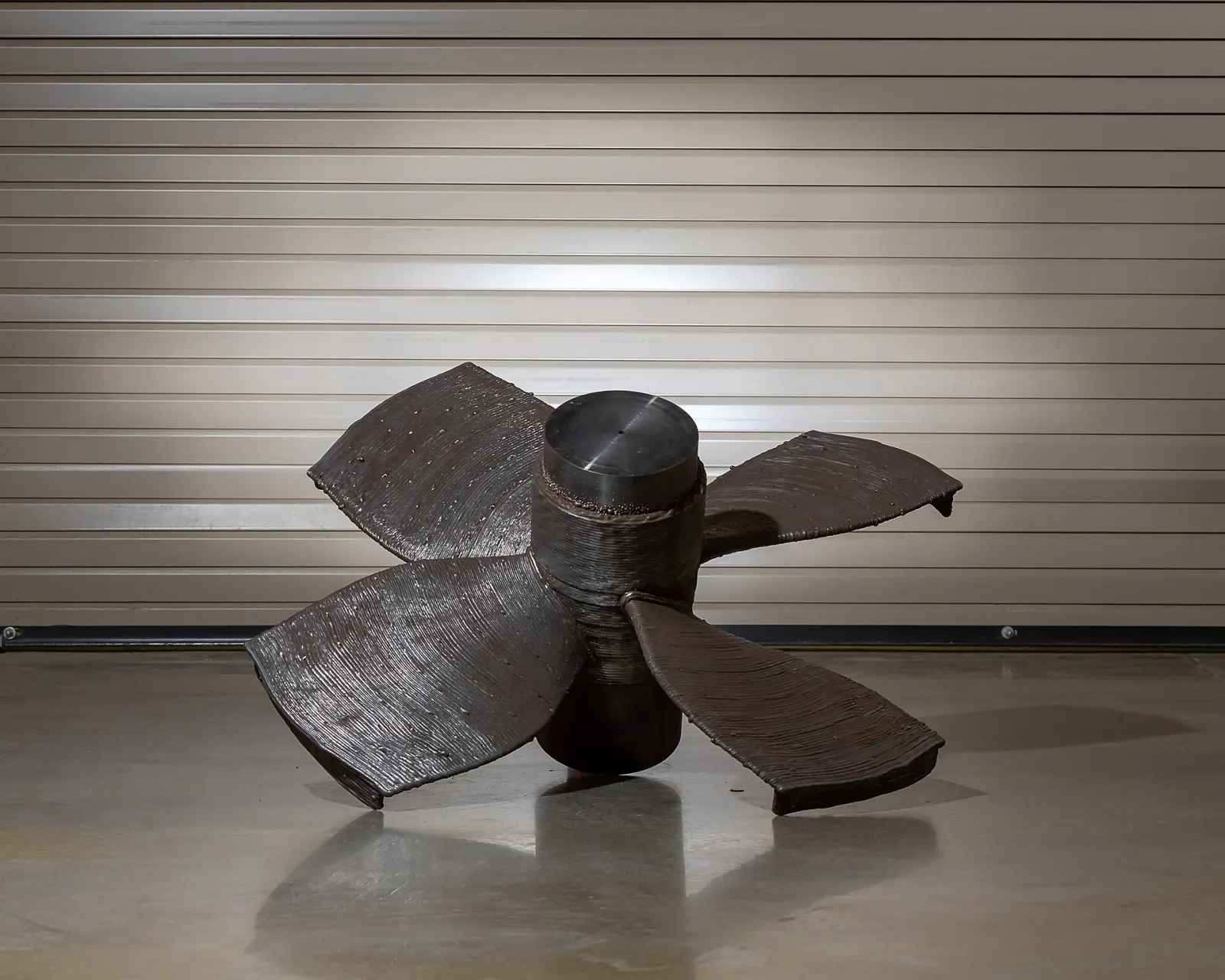
What actually shipped
In March 2026 AML3D (ASX:AL3), an Adelaide-based wire-arc additive manufacturing company, took an order worth about A$2.61 million through BlueForge Alliance to 3D print five high-demand replacement components for US Navy submarines — parts no longer available from the original manufacturer. They are non-safety-critical, printed in nickel aluminium bronze, an alloy AML3D had already qualified to US Navy standards, and the order followed hydrostatic testing of previously printed ARCEMY components by the Navy. In June the company commissioned the first two of six custom ARCEMY X systems for Newport News Shipbuilding, a division of HII, each built around a 10,886 kg positioner for heavy shipbuilding work; four more follow in early 2027 under a second order of about A$9.9 million. A US Navy letter of intent issued in 2025 sets out the demand behind it: a minimum of roughly 400 parts to be produced additively in 2026, rising to about 1,600 by 2030, and up to one hundred additive systems installed across the maritime industrial base.
Why wire, not powder
The additive process that matters for heavy industry is not the powder-bed machine that prints turbine blades in grams per hour. Wire-arc additive manufacturing is a welding robot under closed-loop control: an industrial arm depositing weld wire layer by layer into a near-net shape that is then machined. WAAM3D, a Cranfield University spin-out, quotes deposition of up to 15 kg/h on its RoboWAAM PLUS platform using a patented multi-wire process. That rate, combined with build envelopes measured in metres, is what puts pump and valve bodies, marine components and structural connections inside the technology's reach, and leaves small precision parts to other processes.
The connection you cannot fabricate
The structural case is narrower but real. Aston University researchers found that switching steel portal-frame columns from open sections to tubes could cut up to 40% of frame weight, but only with a rafter-to-column connection whose three-dimensional load paths defeat conventional fabrication. WAAM3D printed the generatively designed geometry — a hollow, branching, truss-like form with 8 mm walls — onto a 20 mm S355 base plate in a single 15-hour build, delivering the prototype in eight days and finish-machining it for flatness and hole accuracy. Two caveats belong in the same breath: it is a half-scale demonstrator, and it is still undergoing 3D scanning, assembly trials and structural testing. Nothing here is yet a code-compliant product.
What the Amsterdam bridge really proved
MX3D's 12-metre stainless steel pedestrian bridge, robot-printed and installed over the Oudezijds Achterburgwal in 2021, is usually cited as proof that structures can be printed. What it proved is narrower and more useful: that a printed structure can be qualified, once, by testing it. Load tests demonstrated capacity to 19.5 tonnes — well above its ultimate design load — and that evidence is what secured the City of Amsterdam permit. A sensor network built by Arup, Imperial College London, Autodesk, the University of Twente and Force Technology fed a digital twin hosted by the Alan Turing Institute for the two-year period of the bridge's operating permit. It was a living laboratory with an expiry date, not permanent infrastructure, and MX3D's own account notes high upfront cost and a multi-year timeline against a conventional footbridge.
The qualification gap nobody has closed
Energy and maritime have a framework. DNV-ST-B203 sets requirements for qualifying additive processes, parts, manufacturers and suppliers, with scrutiny scaled to how critical the part is, and DNV-SE-0568 covers the qualification service around it. Building and civil codes have no equivalent for printed structural steel — no design rules, no standard material properties, no fabrication class. That is precisely why the deployed work is spares and non-safety-critical components, and why every structural application so far has been a bespoke test-and-approve exercise with the approving authority in the room from the start.
The honest economics
At 15 kg/h, a one-tonne component is roughly 67 hours of machine time before machining and non-destructive testing, against a rolled section or a repeat casting produced for a fraction of the cost per kilogram. The market is correspondingly small and lumpy. AML3D, among the most commercially advanced listed players in the field, reported A$3.25 million of revenue for the half year to 31 December 2025 — down 30% on the prior corresponding period, which it attributed to raw-material delays and extended project timelines — and a net loss of A$4.97 million. Additive metal wins on lead time, obsolescence and geometry, not on price per kilo; a business case built on the latter will fail.
What it means for builders and miners
The near-term value in construction and mining is unglamorous: the long-lead casting, the wear component whose OEM has moved on, the one-off connection or repair that would otherwise idle a plant. The capability is also arriving through existing shops rather than new factories — AML3D converted a legacy robotic welding cell at Adelaide's Century Engineering, a supplier to defence, mining, power and water customers, to current printing specification for A$0.28 million. What a shop needs before it can use any of this is the boring part: the drawing, the material specification and the service history of the part being replaced. The bottleneck on a printed spare is almost never the printer.
How to test the claim on your own job
Three questions separate a real additive opportunity from a demonstration. Is the part unavailable or on a lead time long enough that machine hours are cheaper than downtime? Is it non-safety-critical, or can it be qualified by test with the certifying party's agreement before you commit? And can you produce the material specification and dimensional data the printer needs without reverse-engineering a worn component? If the answer to any is no, conventional fabrication remains the right call — and saying so is not conservatism, it is the same judgement the Navy applied when it started with parts nobody else would supply.