 SITELIVE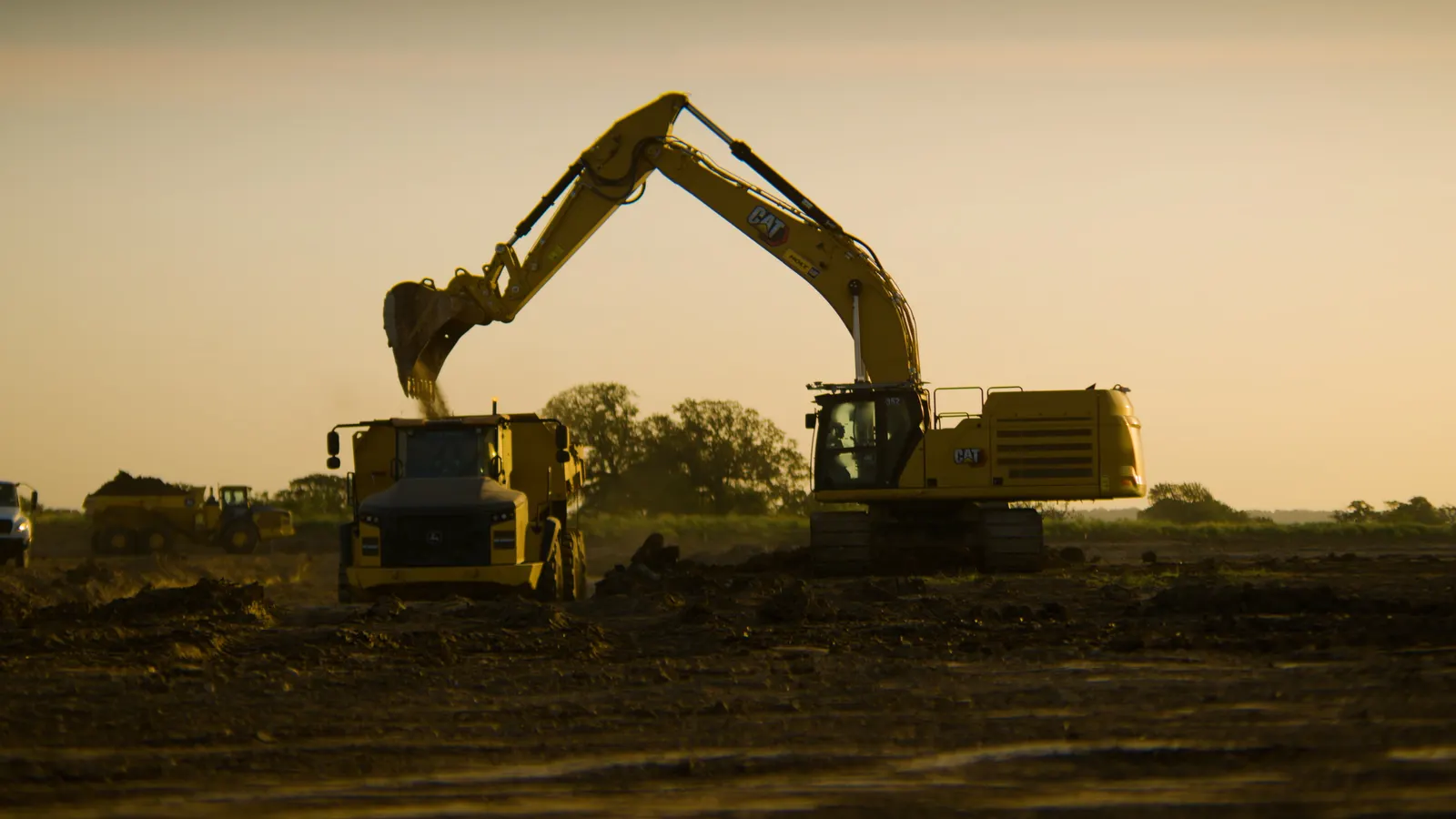
What was announced
On 17 August 2026 Bedrock Robotics announced that excavators fitted with its system are operating fully autonomously on live customer sites, and named three of them: a Nevada water treatment facility with Sundt Construction, a multi-million cubic yard earthwork site with Champion Site Prep in Texas, and a 1.2 million cubic yard civil sitework project with Zachry Construction Corporation. The product is a retrofit, not a new machine — the company says the Bedrock Operator adds a sensor and compute suite to existing fleets in a same-day installation with no permanent changes, and that an end-to-end machine-learning model trained across tens of thousands of hours in the field lets the machine perceive its environment, plan its motion and execute tasks once a site manager sets the initial plan. Bedrock says fifteen contractor partners operate across 23 states, and that it went from founding to commercial deployment in two years with co-founders and much of the early team out of Waymo.
Two things in the announcement are worth reading precisely rather than in summary. The press release describes “a year of rigorous testing on active job sites under human supervision” before operator-out work; the company’s own newsroom post describes two years building a safety system tested in the field under real conditions. Both are Bedrock’s characterisations of its own programme, and they are framed differently. And the operational duty being automated is narrower than “excavation”: Sundt project manager Dan Green describes Bedrock’s technology handling the repetitive truck loading that goes on day after day, freeing skilled operators for specialised work. That is the part practitioners should notice, because it is the honest and the interesting version of the claim.
Why truck loading is the right first target
Bedrock says it chose the excavator because it is roughly a quarter of most fleets, the most versatile machine on site, and the one with more degrees of freedom than nearly anything else — a system that handles it generalises downward more easily than the reverse. The company also says mastering an excavator typically takes five years or more. Set the marketing aside and the engineering logic holds: mass excavation truck loading is the most repetitive, most measurable and most schedulable duty cycle on a civil job. It is the cycle where a machine that never gets bored at hour ten of a night shift is worth the most, and it is the only earthwork task that yields a clean, comparable production number — buckets per truck, trucks per hour, cubic yards per machine hour — which is exactly what a trial needs to be judged on.
It is also the phase that gates everything else. Until bulk earthwork is out, concrete, steel, mechanical and electrical cannot start, so variance in the first phase compounds through the programme. Zachry’s Ranjeet Gadhoke frames the challenge as executing earthwork with precision — moving the right amount of material, at the right time and in the right way. That is a fair statement of the problem whether or not a robot is doing the digging.
The safety claim, stated exactly as it was made
Bedrock says its upfitted excavators can work in normal site conditions alongside other equipment and require no operational barriers; that the machines carry sensor coverage around their full perimeter, closing blind spots that challenge experienced operators; and that if a person or unauthorised object gets too close, the excavator stops automatically until the area is clear. That is a meaningful architectural claim — barrier-free operator-out work on an active commercial site alongside crews is a materially harder problem than autonomy inside a fenced exclusion zone.
What accompanies the claim is not evidence. No functional-safety standard is named, no third-party assessment or certification is cited, and no performance data is published — no detection ranges, no stopping distances, no false-negative or nuisance-stop rates, no intervention rate per machine hour. Compare the path autonomous haulage took in mining, where operator-out fleets scaled against explicit regulatory frameworks, documented safety cases and mandated intervention-capable proximity systems. Nothing equivalent is referenced here, and the absence should be read as “not yet published” rather than as either reassurance or indictment.
The honest limits
There is no production evidence in the public record. Not one cycle time, bucket count, cubic yards per hour, availability or utilisation figure, cost per cubic yard, or comparison against a competent operator on the same material appears in either the release or the newsroom post — for a claim about productivity, that is the entire missing half. The deployment base is three named sites. Every industry statistic in the release is footnoted to third parties and we have not verified those sources: the figures that 20 per cent of construction workers are over 55, that over 40 per cent of the industry may retire within five years, that large projects average 20 per cent over schedule and 80 per cent over budget, and that construction workers are 7.5 per cent of the workforce and 20 per cent of workplace deaths are all Bedrock’s citations, not findings of ours.
Read the partner quotes for tense, too. Champion’s Trey Taparauskas says the technology “will multiply” crew capability and describes “the potential to rethink” fleet coordination; Capitol Aggregates’ Scotty Gerbes says it “can reduce” the most demanding operating hours; Austin Bridge & Road’s Bill Heathcott says technology “has the potential” to further enhance safe performance. These are statements of expectation from contractors who have chosen to work with the company — which is legitimate and worth reporting, but it is not measured outcome, and no partner states a production or safety result achieved.
None of this transfers automatically to Australia, where there is no operator-out autonomous excavation on a construction site. Earthmoving plant does not sit in a high-risk work licence class — excavator operation is not in Schedule 3 of the model WHS Regulations, unlike cranes, forklifts and elevating work platforms — so competency is verified by the employer, and the person with management or control of the plant carries the duty to manage its risks under the model Code of Practice. There is no licence class, no approved code and no established acceptance route for a machine that digs with nobody in it near a working crew. A contractor bringing this here would be writing that safety case itself, from first principles, with the vendor’s data as an input rather than an answer.
What it means for operators
If this reaches your tender or your yard, the trial specification writes itself, and none of it is about the robot. Demand production rate against your own baseline — same material, same haul, a known operator as the control. Demand availability and, above all, intervention rate: how many times per shift a human took over, what triggered it, and how long recovery took, because that number is what separates a demonstration from a deployment. Demand exclusion-zone behaviour tested against your traffic management plan, not a generic scenario. Settle who the competent person is when the seat is empty, in writing, for both regulatory and insurance purposes. And settle data: what the machine records, how it exports, who keeps it, and how long it survives, because those logs are your only evidence of what happened if something goes wrong.
The unglamorous precondition is that none of it is measurable unless you already record earthwork production and plant hours to a standard you would defend. If your current baseline is a superintendent’s recollection of a good week, an autonomy trial will produce a story rather than a result — and you will have no way to tell which one you got.