 SITELIVE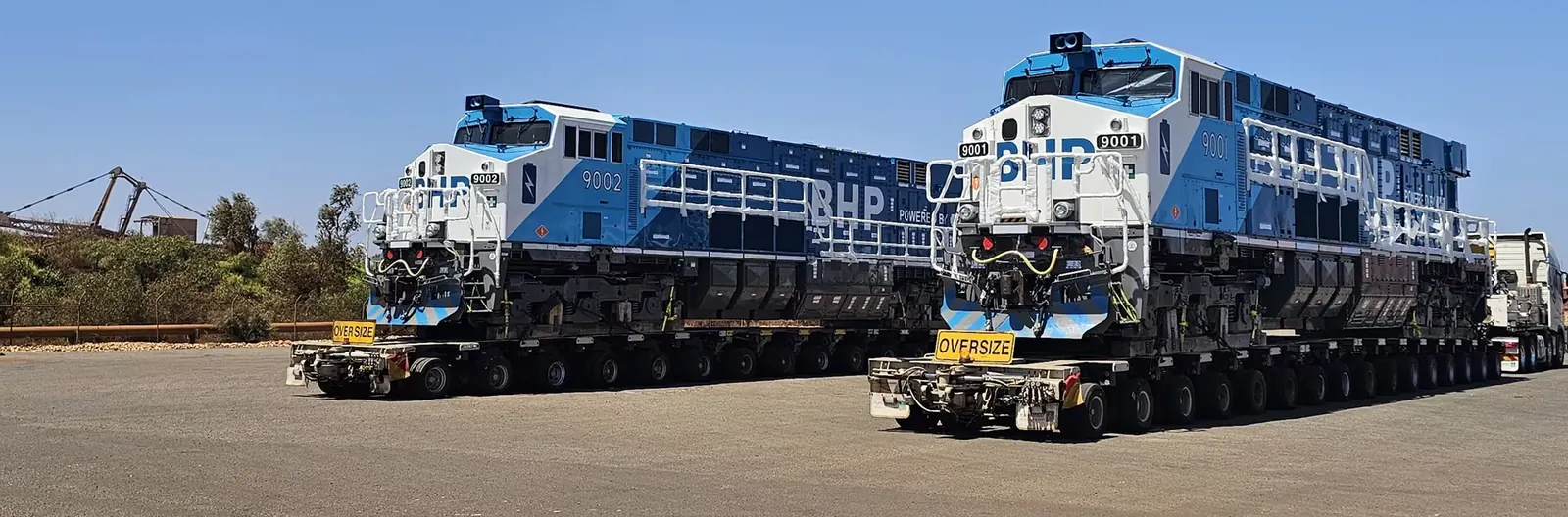
What BHP published
In a case study dated 18 August 2026, BHP says it has commenced proof-of-concept trials of battery-electric haulage technologies at its Pilbara operations. The truck half is two battery-electric haul trucks running on a dedicated test track at Jimblebar, with the stated purpose of generating practical insight into range, energy consumption, battery behaviour, charging performance, reliability, safety and overall productivity — plus structured feedback from operators, maintenance teams and project personnel. The rail half is further along: in FY2026 BHP began commissioning two purpose-built Wabtec FLXdrive heavy-haul battery-electric locomotives at Port Hedland, and two further locomotives from Progress Rail were delivered to Perth in FY2026 and are to be moved to Port Hedland for commissioning and testing in FY2027.
BHP does not name the truck manufacturer in this case study, and we are not going to fill that gap by inference. What is on the record is the May 2024 media release in which BHP, Rio Tinto, Caterpillar and Komatsu set out a shared testing plan: two Cat 793 haul trucks to be trialled from the second half of 2024 and two Komatsu 930 trucks tested from 2026 at Pilbara sites, with BHP trialling the Caterpillar machines, Rio Tinto the Komatsu ones, and outcomes shared between the two miners. That release also describes the trials as the first stage of battery-electric haul truck testing at both companies’ Pilbara operations.
The locomotives are better documented because they were an event. BHP’s November 2025 article records the arrival at Port Hedland of what it describes as the first brand-new, purpose-built battery-electric locomotives in Australia, delivered in partnership with Wabtec, each with a 7 MWh battery system and regenerative braking that captures energy during downhill braking and returns it to the battery. Wabtec’s original 2022 order announcement put the same 7 MWh figure on the units and said that, based on the topography of the route and BHP’s rail operations, the FLXdrive was anticipated to reduce fuel costs and emissions by double-digit percentages per train.
Why the rail half is the more interesting experiment
Two things make the locomotive programme the part worth watching. The first is physics. Pilbara iron ore rail runs loaded from the mines to the port and empty back, so a battery in the consist is charged by the loaded run through regenerative braking and spends that energy hauling the empties inland — which is why both BHP and Wabtec describe the saving as a function of route topography and quote it per train rather than per litre. Heavy-haul rail with a favourable loaded direction is one of the few large duty cycles where a battery does not need a charger to be useful.
The second is experimental design. BHP says that once locomotives from both manufacturers are in trial it expects to be one of the first mining companies globally to run side-by-side evaluations of battery-electric heavy-haul locomotives from two suppliers within the same operating environment. Same track, same tonnage, same heat, same crews, two OEMs. Genuine like-for-like comparisons of heavy equipment are rare in this industry precisely because sites differ so much, and a two-supplier comparison on one railway will produce more usable engineering information than a dozen single-vendor pilots on a dozen sites.
The honest limits
This is a proof of concept, and BHP calls it one. Two trucks on a dedicated test track is not production haulage: no live pit traffic, no queue at the shovel, no ramp under load with a full fleet around it, and no published range, energy consumption, availability or charge-time figures. Four locomotives across a network that moves hundreds of millions of tonnes a year is a trial fleet, and BHP has published no figure for what share of its rail task they could carry. There is no capital cost, no charging-infrastructure detail, and — explicitly — no commitment on adoption: BHP says the insights will inform decisions on future trial expansion and help determine how and when the technology could be adopted at scale.
The public timeline also does not line up neatly. The May 2024 release said the Cat trucks would be trialled from the second half of 2024; the August 2026 case study describes proof-of-concept truck trials as having commenced. Either the schedule moved or the two statements use “trial” differently, and BHP has not reconciled them publicly. That is worth stating plainly rather than reading either way, because programme slip is the norm in heavy-equipment trials and pretending otherwise is how unrealistic expectations get set for everyone downstream.
What BHP does say about the early findings is the most valuable content in the release, and it is qualitative. Electrification is reinforcing itself as a system-level transformation rather than a simple replacement of diesel equipment; it is expected to increase electricity demand; and fleet electrification planning has to be integrated with site power strategy, particularly at remote operations where charging demand, peak loads and system reliability all have to be managed. That is an honest description of the actual gate — generation, distribution and charging — with no numbers attached to any part of it.
What it means for operators
The transferable lesson scales down cleanly to a quarry, a plant yard or a civil job with a handful of electric machines: the equipment decision is downstream of the energy decision. Before comparing machines, model the peak charging load against what the site can actually supply, and treat charging windows as a scheduling constraint that competes with production rather than as refuelling. A diesel bowser does not care when you turn up; a charger does, and on a constrained supply the site’s peak demand charge decides whether the machine was a good buy.
And a trial only pays if the baseline exists first. Energy per tonne-kilometre or per cubic metre moved, availability, charge time as a share of shift, derate behaviour on a 45-degree day, and maintenance labour hours — recorded per machine and per shift, on the diesel plant you already run, before the electric machine arrives. Most electrification pilots produce an anecdote rather than a decision because nobody wrote down what the incumbent actually did.