 SITELIVE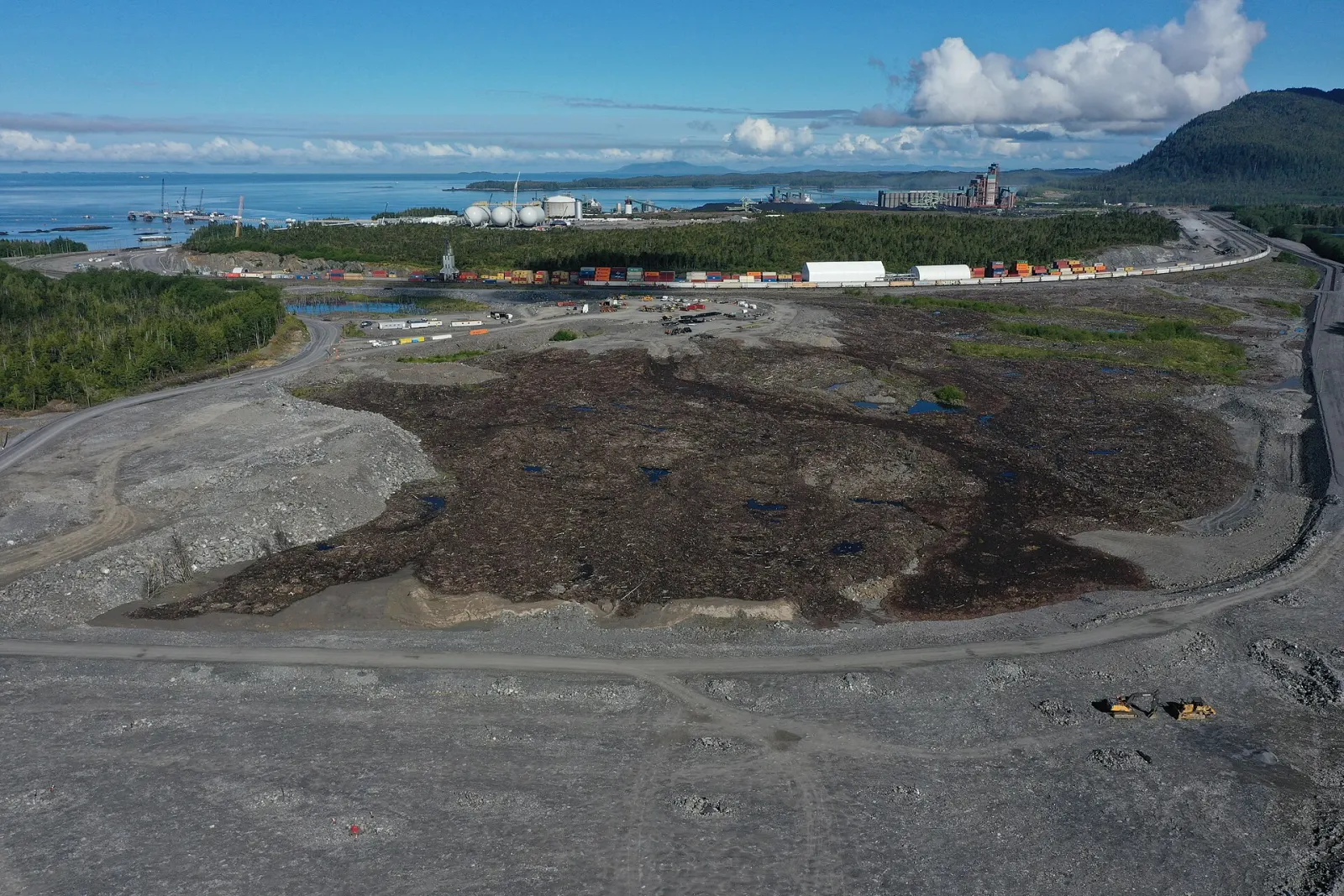
What opened
On 28 August, Ray-Mont Logistics, Canadian National Railway and the Prince Rupert Port Authority announced the grand opening of CANXPORT, a C$750 million export logistics facility at the Port of Prince Rupert in British Columbia. The facility does one thing at scale: rail-to-container transloading. Product arrives by rail — the release names petrochemical, forestry, agriculture and mining commodities — and leaves in shipping containers on vessels bound for Asia. The stated capacity is up to 400,000 twenty-foot equivalent units of rail-to-container transloading a year, with the release describing an ability to increase capacity to 750,000 TEU for bulk and breakbulk commodities in future.
The supporting works are as much of the story as the shed. CN says its investment expanded the Zanardi Rapids Bridge and increased rail corridor capacity into the port. The development contract for the site was awarded by the port authority to an Indigenous joint venture including Metlakatla First Nation, Lax Kw’alaams Band, Gitxaała Nation and IDL Projects Inc.; Metlakatla and Lax Kw’alaams are also majority owners of Gat Leedm Logistics, described in the release as the main provider of truck drayage at the port. Public funding is itemised: a C$150 million loan from the Canada Infrastructure Bank, which the release calls the bank’s first-ever investment in a port project, nearly C$50 million from Transport Canada’s National Trade Corridors Fund, and C$25 million from the Province of British Columbia’s StrongerBC programme. The release positions CANXPORT as the first of a series of projects in a C$3 billion expansion of the gateway.
Why transloading is the interesting part
Containerising bulk is an unglamorous arbitrage and it is where a lot of export margin now lives. A grain, pellet, resin or concentrate producer inland ships in rail cars because rail cars are cheap per tonne over long distances; the customer on the other side of the Pacific increasingly wants boxes, because boxes fit their inland distribution, their financing and their quality control. Somebody has to break the rail car and fill the container, and where that happens determines who pays for the empty repositioning, who carries the dwell risk, and how much of the vessel’s window a shipper can actually hit. Doing it at the port, on a site served directly by the mainline and adjacent to the container terminal, removes a truck leg and a second handling from the chain.
Prince Rupert’s specific advantage is geography and depth: the release describes it as North America’s closest West Coast port to Asia and Canada’s third-largest port with the deepest natural harbour on the continent, handling 26.3 million tonnes of cargo in 2025, a 14% increase on 2024, and shipping C$8.1 billion of Canada’s exports. For an export corridor whose constraint has historically been rail capacity rather than berth, a bridge expansion and corridor upgrades landing at the same time as the transload capacity is the coherent version of this investment.
The honest limits
Everything published is capacity, not throughput. “Up to 400,000 TEU” is a design figure on opening day; the release gives no commissioning ramp, no committed volumes, no customer contracts, no utilisation forecast and no split by commodity. The 750,000 TEU figure is explicitly a future possibility for bulk and breakbulk, not installed capacity. There are no operating metrics of the kind that decide whether a transload facility works — rail car turn time, container dwell, transload cost per tonne, empty availability, or the vessel-window reliability that shippers actually buy. Nor is there a published tariff.
The economics are also policy-shaped. Roughly C$225 million of the C$750 million capital came from a federal infrastructure bank loan, a federal trade corridor fund and a provincial programme, which tells you the private return alone did not carry it and that the project is exposed to trade-diversification policy holding its current direction. Commodity flows through a facility like this are cyclical: petrochemical and forestry volumes in particular can move by double digits year on year for reasons that have nothing to do with how well the site is run. And the release quotes ministers, chief executives and a customer, which is normal for an opening — but a quote is not a volume commitment.
What it means for operators
For anyone hauling or exporting on the western Canadian corridor, the practical question is not the headline capacity but what changes in your own chain: whether a rail-direct transload at the port removes a truck leg you are currently paying for, what it does to your dwell exposure and demurrage risk, and whether empty container availability at Prince Rupert is genuinely better than the alternative you use today. Ask for measured cycle times rather than design capacity, and ask them again in six months when the ramp is real.
The broader pattern is worth noting by anyone running heavy haulage or bulk logistics anywhere: the value in these projects is created at the interfaces — rail to pad, pad to box, box to vessel — and interfaces are where evidence goes missing. Every transload is a custody transfer with a weight, a time, a condition and a document, and the operators who can produce that record per load are the ones who win the argument about who caused the delay or the damage. That is true on a C$750 million pad at a deepwater port and it is true on a quarry weighbridge.