 SITELIVE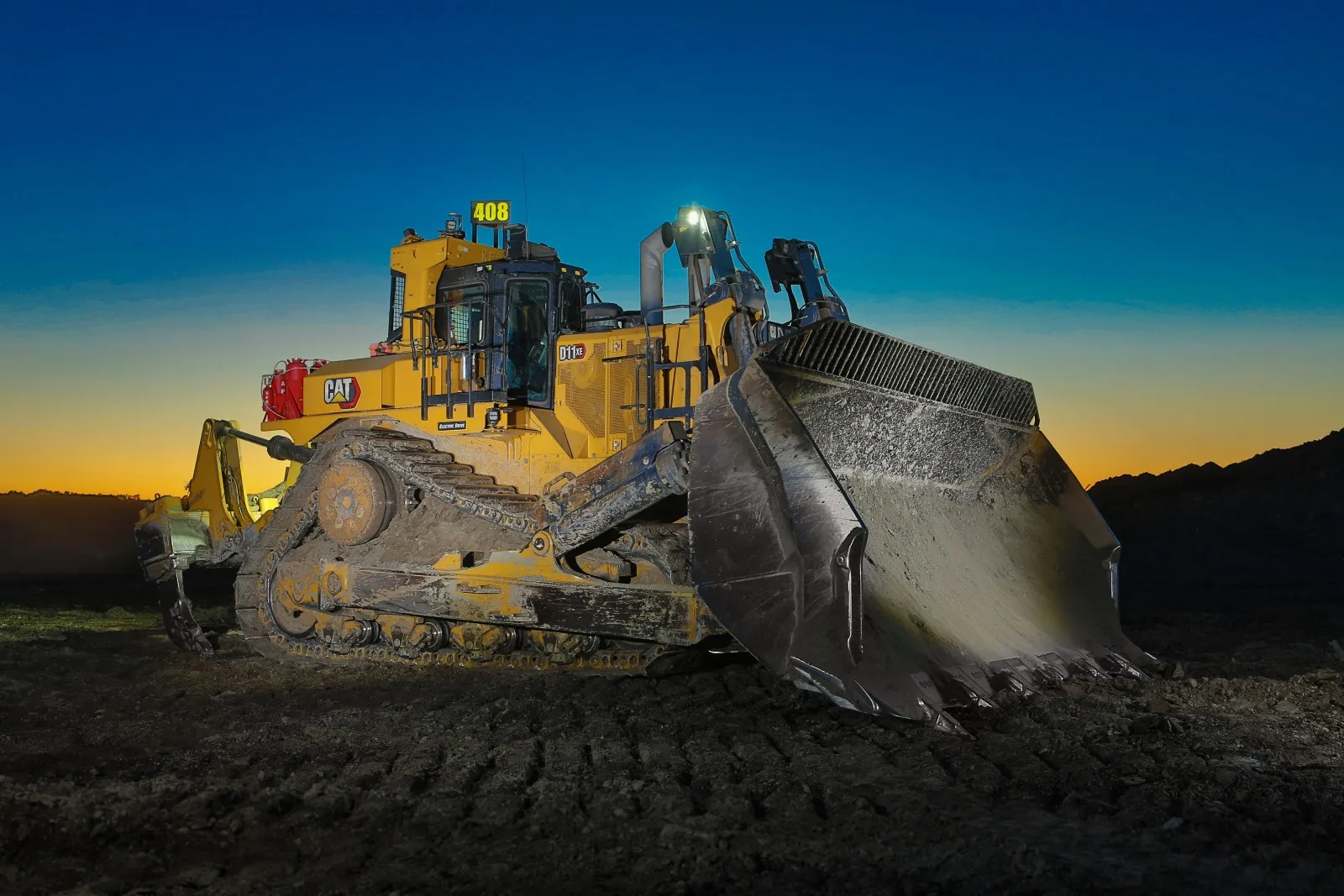
What Caterpillar announced
On 9 September 2026 Caterpillar announced the Cat D11 XE, which it describes as its first electric-drive large dozer. The company’s claims against the current next-generation D11 are specific: up to 25% less fuel consumed per unit of material moved, 5% to 10% more material moved per hour, up to 10% more power to the ground, up to 20% less fuel per hour and 20–25% fewer greenhouse-gas emissions. The drivetrain has, Caterpillar says, 60% fewer moving parts than a mechanical drive. The published specification puts net forward power at 642 kW (861 hp) from a Cat C32B engine, net reverse power at 715 kW (959 hp) in Tier 2-equivalent form or 712 kW in Tier 4 Final/EU Stage V form, infinitely variable speed from 0 to 11.2 km/h, an operating weight of 108.3 to 117.0 tonnes depending on blade and ripper, and blade capacities of 27.2 m³ (semi-universal), 34.4 m³ (universal) and 43.6 m³ (Carrydozer).
Mechanically, the change is the removal of the bevel gear and the transmission. The engine drives a generator, power passes through an inverter to two motors, and each track has its own drive motor. Caterpillar says that gives power-turn capability — both tracks powered through a turn — and does away with gear shifting. The C32B runs at a lower high-idle speed than the C32 in the D11, and the company credits that for up to 20% longer engine life between rebuilds. Planned component repair intervals for the engine, final drives and hydraulics rise from 15,000 to 18,000 hours to match what Caterpillar calls the electric drive’s 18,000-hour rebuild centreline. The generator and motors are designed, it says, to last through two machine lives with only rebearing and resealing, and the D11 XE keeps up to 85% parts commonality with the D11.
Why the 2021 release is the one to read alongside it
The D11 XE is not new as an idea. Caterpillar previewed it at MINExpo in Las Vegas in September 2021 and published targets: up to 25% lower fuel cost per bank cubic metre, up to 20% longer engine rebuild cycles than mechanical-drive models, 60% fewer moving parts, and a claim that it would be the world’s largest and most powerful electric-drive dozer with high drive when in production. The 2021 release said the machine was operating at the Peoria proving grounds and would complete “an extensive field validation plan before entering full production.” Five years later the production release restates those numbers essentially unchanged, which is the useful signal: the field validation did not force the targets down. It also means a buyer can hold the machine to a published claim that has been on the record since 2021.
Electric drive on a dozer is also a different proposition from electric drive on a haul truck. The 2021 release leaned on “20-plus years of Cat electric drive experience and field application,” which is a claim about component maturity, not novelty. The engineering case on a dozer is about continuous power to the ground through a push and a turn, where a mechanical transmission is shifting and shedding torque, and about taking the highest-wear mechanical components — bevel gear, transmission, torque converter — out of a machine that lives its whole life at full load in abrasive ground.
The honest limits
Every performance number in the release is qualified by “up to” and compared against Caterpillar’s own D11, and none of it is tied to a named mine, a material type, a push distance or a duty cycle. Dozer fuel per unit moved swings widely with material, slot-dozing versus open-cut, grade and operator, so a fleet manager should read 25% as the top of a range measured under conditions Cat has not published. The release gives no fuel burn in litres per hour, no cost, no availability figure, no lead time and no statement about which regions get Tier 2-equivalent versus Tier 4 Final/Stage V machines first. The 18,000-hour rebuild centreline is a design interval, not yet an achieved fleet average, and “two machine lives” for the generator and motors is a durability target that cannot have been demonstrated in service on a machine that has just entered production.
The emissions figure is also a per-hour and per-unit diesel efficiency figure, not a decarbonisation step: this is a diesel machine with an electric drivetrain, burning less fuel to do the same work. The 5–10% productivity gain is the number most exposed to operator behaviour, because electric drive removes gear shifting and rewards a steady push, and a site will see it or not depending on how its operators and its Command or AutoCarry settings are configured. The release does not say how much of the gain is attributed to drivetrain and how much to the automation features it lists as available.
What it means for operators
For mines running D11 fleets, the practical question is where the machine slots into a replacement cycle, and the release gives the two figures that matter for that calculation: a repair interval moving from 15,000 to 18,000 hours across engine, final drives and hydraulics, and one fewer rebuild over a machine life at similar total hours. Those are the numbers to put into a life-cycle model against the site’s own D11 rebuild history, not the fuel percentage. On fuel, the honest way to test the claim is a side-by-side trial on the same pit, same material and same operators, with litres and bank cubic metres counted per shift, because “up to 25%” will be a different figure on every site.
For contractors and quarries, this is a mining-class machine and most will never own one, but the pattern matters: OEMs are now shipping electric drive on tracked machines where continuous power and reduced drivetrain wear justify the inverter and generator, and Caterpillar’s 2021 release positioned the D11 XE as the world’s largest electric-drive dozer with high drive. The evidence that will settle whether the D11 XE’s claims hold is the same evidence a site needs anyway — fuel per hour, hours between component change-outs and bank cubic metres per shift, logged per machine.