 SITELIVE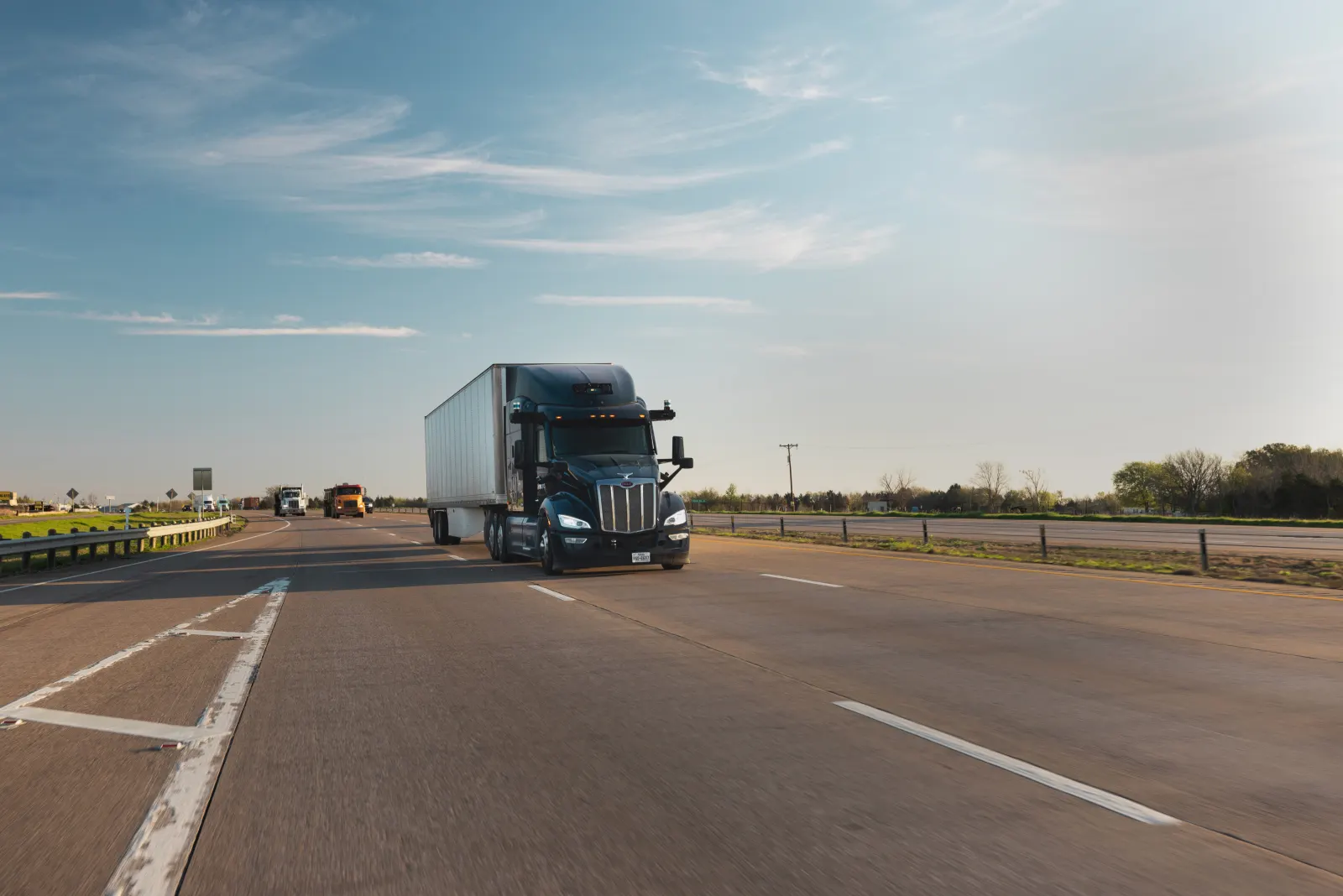
What was disclosed
Two listed autonomous trucking companies have now reported a full quarter of driverless commercial operations, in documents they are accountable for. Aurora Innovation (Nasdaq: AUR) told shareholders on 29 July 2026 that the Aurora Driver had completed nearly 440,000 driverless miles since launch through the end of June, with a 100 per cent on-time performance record and zero Aurora Driver-attributed collisions. A week earlier it launched a second-generation driverless fleet based on the International LT series, deployed across a commercial network of ten driverless routes in the US Sun Belt, and it says it is "fully allocated" to exit the year with 200 driverless trucks in operation.
Kodiak AI (Nasdaq: KDK) reported on 6 August 2026 that it deployed seven more driverless trucks in the quarter for a total of 35 customer-owned driverless vehicles, passed 40,000 cumulative hours of paid driverless operations — a 71 per cent increase on the end of Q1 — moved more than 300,000 tons of freight in the quarter, and exceeded 20,000 cumulative loads delivered, about 32 per cent growth on Q1. It also put a number on its own readiness for long-haul: an internal "Autonomy Readiness Measure" of 91 per cent as of July, against a stated target of driverless long-haul launch by the end of the year.
Why the disclosure format matters more than the milestones
For a decade, autonomous freight was reported in demonstrations. What changed this quarter is the unit of account: both companies are now publishing operating counters — miles, hours, loads, tons, trucks in service — inside shareholder letters and results releases, quarter on quarter, where the previous quarter's number is on the record and the growth rate is checkable. That is the same shift that made mine-site autonomy credible: not the first driverless lap, but the year-on-year utilisation table.
The engineering disclosures point the same way — towards fleet operations rather than capability demos. Aurora says its second-generation hardware is built to last one million miles, and that its upfitter Roush is ramping to an annual production run-rate of 1,000 trucks; Kodiak's Gen7 platform is described as a more compact design with nearly 50 per cent more compute than Gen6 and, on stress testing, nearly 50 per cent greater expected operational lifetimes for its SensorPods and compute enclosures, including a lower-cost day cab configuration. Compute per truck is no longer the constraint being solved. Serviceable hardware life, upfit throughput and cost per truck are.
The honest economics
The revenue lines are the discipline here. Aurora reported second-quarter revenue of $2 million across driverless and vehicle operator-supervised commercial loads, against an operating loss of $266 million including stock-based compensation, roughly $225 million of operating cash used in the quarter and $31 million of capex; it ended June with $1,217 million in cash and short-term investments and expects existing liquidity to be sufficient to reach positive free cash flow in 2028, with an anticipated $80 million revenue run-rate exiting 2026. Kodiak reported $3.5 million of Q2 revenue, 91 per cent growth quarter-on-quarter, with $34.1 million of net cash used in operating activities, negative $38.1 million of free cash flow and $151.1 million of cash, cash equivalents and marketable securities. Nine-figure quarterly losses against single-digit-million revenue is the actual state of the industry, and both companies publish it plainly.
The operating metrics also need reading carefully, because they are company-defined and not comparable with each other. Aurora counts driverless miles; Kodiak counts paid driverless hours, loads and tons. Neither publishes cost per mile, cost per load, disengagement or remote-assistance rates, or utilisation per truck per day — the four numbers a fleet actually prices against. "Zero Aurora Driver-attributed collisions" is Aurora's own attribution of its own incidents, not an independent finding, and Kodiak's Autonomy Readiness Measure is an internal construct with no published methodology. Much of Kodiak's driverless volume is repetitive short-haul work in the Permian Basin, including a second simultaneous load-out point on Atlas's 42-mile Dune Express sand conveyor — the easiest possible operating design, and deliberately so. Long-haul driverless remains a target for both, not a delivered service.
What it means for operators
Australian haulage is not about to be tendered against driverless line-haul; there is no equivalent public-road driverless freight service here, and the country's autonomy at scale sits on private mine haul roads. But the procurement lesson travels now. When these systems are quoted into a fleet — as Driver-as-a-Service, per mile or per load — the comparison you need is not the vendor's safety record, it is your own cost per loaded hour on the same lane, with standing time, waiting-to-load, and rework included. Most fleets do not have that number to two decimal places, which is precisely why autonomy business cases get argued on brochure figures.
So build the baseline before the pitch arrives. Instrument one corridor properly for a quarter: cycle times, queue and load times, actual utilised hours per truck per day, and the cost of every hour a truck is on site but not moving. Then read a vendor's quarterly counters against it. Autonomy vendors are now publishing their operating data every 90 days; the fleets that can do the same to their own operations are the only ones who will be able to tell a good deal from a good deck.