 SITELIVE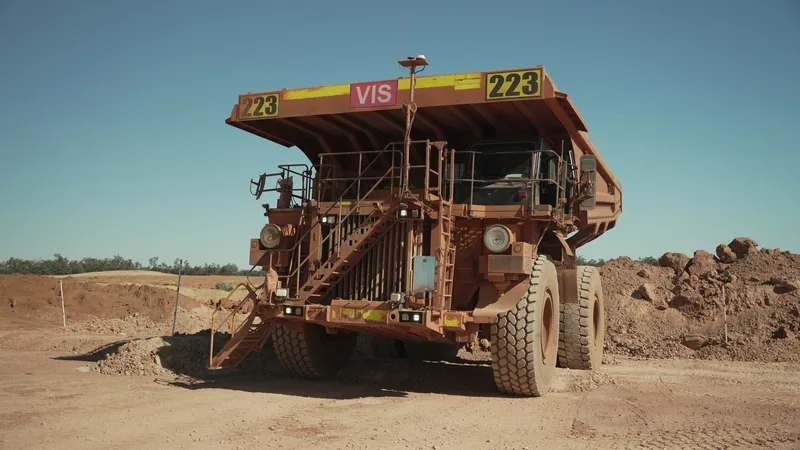
What Hexagon announced
On 3 September 2026 Hexagon’s Mining division announced the global launch of its next-generation Vehicle Intervention System (VIS), which it describes as “an advanced safety solution designed to help surface mining operations prevent collisions before they occur.” The release positions the system as an EMESRT Level 9 vehicle intervention system: one that “can automatically take control of a machine in defined high-risk situations when safety thresholds are breached.” Hexagon’s product page is more specific about the trigger — VIS acts on the truck’s propulsion system “if the operator does not react appropriately to a warning” from the company’s Collision Avoidance System or Operator Alertness System, and calls that “a last resort to mitigate the consequences of a collision.”
The release lists what the new generation can do: inhibit propulsion, apply retardation or braking, enforce safe following distances, manage overspeed conditions including on ramps, and bring the vehicle to a safe state if a critical system fault is detected. It groups those into collision prevention (vehicle-to-vehicle, vehicle-to-person, vehicle-to-obstacle), rule enforcement (speed limits and following distance), fail-safe protection (continuous health monitoring) and what it calls OEM flexibility — support for a broad range of vehicle types and manufacturers “without OEM lock-in.” Hexagon says VIS has been deployed in production environments since 2018 across four continents; the product page dates the original launch to 2017 after more than 10,000 hours of testing in a working mine.
Why Level 9 and TRL4 are the substance
EMESRT, the Earth Moving Equipment Safety Round Table of mining companies, frames vehicle interaction as a nine-layer defence model that runs from site design and procedures through operator awareness and advisory systems to, at the ninth layer, machine intervention. The body’s own justification for the work is stark: it cites ICMM member data attributing 30–40% of industry fatalities each year to failures of vehicle-interaction controls, about half of those involving pedestrians. Detection and warning — the advisory layers — are what most collision-avoidance systems on haul trucks do today. Level 9 is the layer that acts when the warning fails, and it is the layer mines have been slowest to adopt because a system that can brake a 200-tonne truck on its own has to be trusted not to do so wrongly.
That is why the March result matters more than the September ribbon. Hexagon’s mining blog reported on 20 March 2026 that the latest-generation VIS had passed the University of Pretoria’s Collision Prevention System Technology Readiness Level 4 test specification, the first open-pit Level 9 system to do so. The university runs that test in controlled laboratory and proving-ground conditions under the Minerals Council South Africa framework, and Hexagon lists the scope as independent assessment of detection and tracking, early-warning functionality, control functions, logging, ISO 21815 compatibility, and fail-to-safe and self-diagnostics. Passing TRL4 is described as a stage gate in South Africa’s MOSH initiative before technologies go to integrated field deployment. South Africa is the jurisdiction that has pushed hardest on mandating collision prevention on trackless mobile machinery, which is why an independent South African test result is the credential to carry.
The honest limits
A TRL4 pass verifies that the standalone system does what it says on a test track. It does not tell a mine how the system behaves at 3 a.m. in dust on a wet ramp with a light vehicle coming the other way, and Hexagon has not published field data for the new generation: no intervention counts, no rate of unnecessary interventions, no availability figures and no customer names. The release’s statement that it delivers “the highest level of collision intervention available in open-pit mining” is a claim about the EMESRT layer it occupies, not a measured comparison against competing systems. Nor does the release say how the new hardware and software differ from the version fielded since 2018 beyond “expanding intervention coverage and improving system precision.”
The economics are also unstated. An intervention system needs an interface to each truck model’s propulsion, retarder and brake controls, and “OEM flexibility” in practice means an integration exercise per model, per site, with the OEM’s cooperation or without it. Hexagon offers no pricing, no fit time per truck and no statement about warranty implications where a third party takes control authority on an OEM machine. And every Level 9 system carries the risk the industry knows well from earlier proximity-detection rollouts: a system that trips too often gets defeated by the people it is meant to protect. The release does not address false-trip rates at all.
What it means for operators
For open-pit operators, particularly those with South African assets or with corporate standards that reference EMESRT and ISO 21815, this is a second-generation Level 9 product with an independent stage-gate result behind it, and that changes the procurement conversation from whether intervention is feasible to how a specific site would trial it. The first work is not on the truck: it is a review of the site’s vehicle-interaction risk register against the nine layers, to establish which interactions the advisory layers are already controlling and where an intervention layer would actually reduce residual risk.
For anyone running a trial, the data the system logs is the point. A Level 9 system records every warning, every intervention and every fault, and the university’s test scope includes logging for a reason: the log is how a site proves the system intervened when it should have and did not when it should not have. Contractors and quarry operators outside mining should note the direction of travel, because the same collision-avoidance stack is what ends up on civil earthmoving fleets a few years later, and the client and the regulator will both ask for the record.