 SITELIVE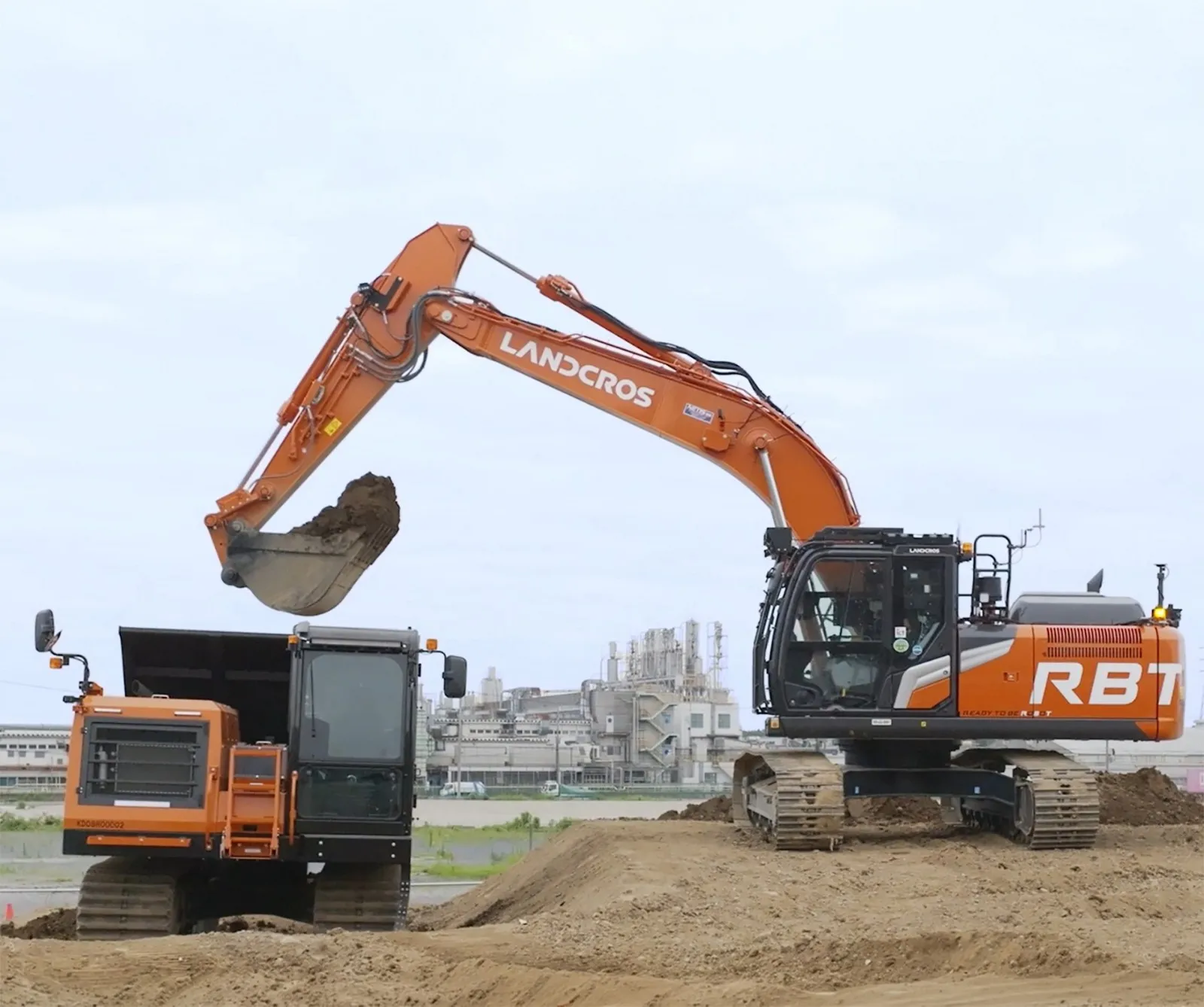
What Hitachi announced
On 9 September 2026 Hitachi Construction Machinery said it will begin research and development in October 2026 of what it calls Physical AI that learns hydraulic excavator operator skills. The project has been selected for GENIAC, the Generative AI Accelerator Challenge run by Japan’s Ministry of Economy, Trade and Industry and the New Energy and Industrial Technology Development Organization, under NEDO’s robot-foundation-model research programme. Hitachi will lead, collect the excavator operational data and build and verify the R&D environment; Jizai, Inc. will research the data-utilisation technology and training environment; and the Nara Institute of Science and Technology will research and develop the foundation model itself.
The method is stated plainly. The AI will be trained on operator lever operations together with camera images and work instructions, so that it can “determine and execute appropriate operations based on site conditions.” Hitachi says it will collect extensive operator work footage and operation logs across a deliberately wide range of conditions — regular operation, recovery from operational errors, weather, surrounding environment, machine condition and object positioning. It frames the target as a machine that runs the full loop of perception, decision and action, and distinguishes this from what it calls mere mechanical automation. The eventual applications named are debris removal at disaster sites and excavation and loading at construction and mining sites; the release also lists material handling, forestry, demolition and civil engineering as fields for later deployment.
Why the training-data sentence is the substance
Most autonomous-excavator work on live sites today — Bedrock Robotics’ operator-out loading in the United States, which this desk covered in August, is the example — is built on explicit perception, planning and control stacks with learned components inside them. Hitachi is describing the other route: a foundation model trained by imitation on what skilled operators actually did with the levers, conditioned on what the cameras saw and what the instruction was. That is the approach that has moved fastest in general-purpose robotics over the last two years, and it has an obvious attraction for excavation, where the “correct” bucket path through a heap of mixed rubble is something experienced operators know and nobody has written down as rules.
Two details in the release are the ones a practitioner should register. First, Hitachi intends to include recovery from operational errors in the training data, which is the part imitation learning usually lacks — a dataset of only clean work teaches a model nothing about what to do when the bucket stalls or the track slips. Second, the data is being collected by the OEM, on its own machines, under a national programme. Hitachi sells excavators, wheel loaders and mining trucks globally and already operates an autonomous haulage system and the ConSite telematics service, so it has both the fleet access to gather operator data at scale and a commercial reason to keep the resulting model on its own iron.
The honest limits
This is the start of a research programme, and the release is careful to say so. It gives no completion date, no budget or subsidy amount, no number of operators or machines contributing data, no hours of footage to be collected, and no target for what the model should be able to do, on what class of machine, to what accuracy, by when. Nothing has been demonstrated: the applications listed are aims, and disaster-site debris removal in particular is an environment where the operating conditions are the hardest to reproduce in a training set. Physical AI is also a vendor and industry term, not a standard with a defined capability level, and the release’s statement that it is “increasingly applied to industrial robots, humanoid robots, etc.” describes the broader field, not anything Hitachi has fielded on an excavator.
The economics are unstated because they cannot yet be known. A model trained on Japanese operators on Hitachi machines does not obviously transfer to a different OEM’s hydraulics, a different bucket, or a different country’s soil and site practice, and the release does not discuss transfer, retraining or how work instructions would be issued to the machine on a real job. Nor does it address the questions that will decide adoption — safety cases, how a site supervises a learned policy, and who is liable when it digs into a service — which are reasonable omissions for an R&D announcement and unreasonable ones for any product that follows it.
What it means for operators
Nothing changes on site this year. What the announcement confirms is where the major excavator OEMs are placing their autonomy bets: on learning from operators rather than programming around them, and on national programmes to fund the data collection. For contractors, that has one near-term implication and one long-term one. Near term, the operator record — who ran which machine, doing what, in what ground — is becoming a training asset, and the release is explicit that recovery from errors is part of what is valuable. Long term, if this route works, the excavator that arrives on a site in the 2030s will carry a skill set learned from other people’s operators, and the question of whether it can do the job will be answered by logged evidence from its own work, not by a specification.
For the industry’s experienced operators, this is also the clearest statement yet by a top-tier OEM that their skill is the thing being modelled. The dataset Hitachi describes — lever inputs paired with what the operator saw and was asked to do — is a description of expertise, and the shortage of it is the problem the project is explicitly funded to address.