 SITELIVE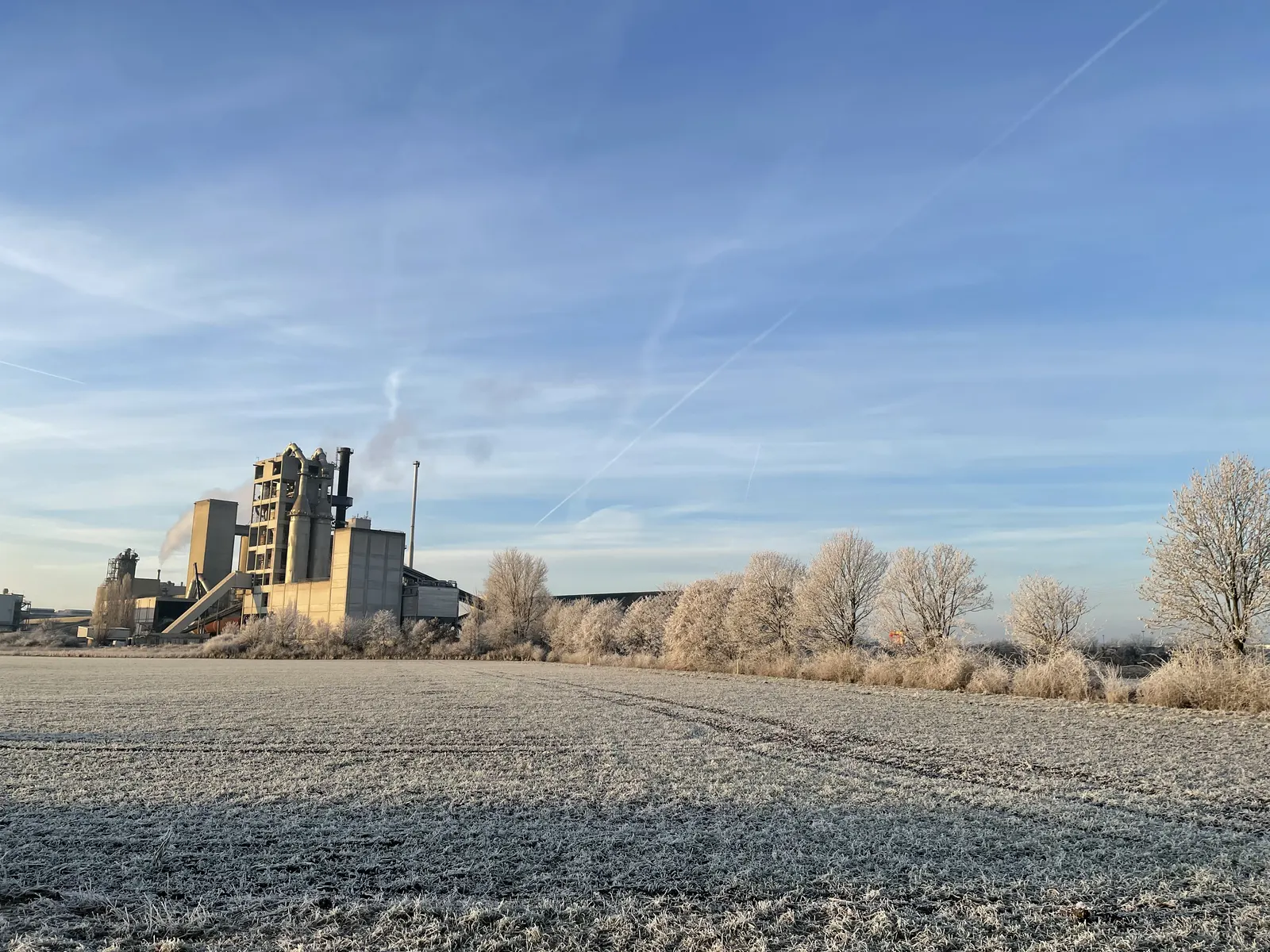
What was commissioned
On 21 August, Holcim Deutschland put a test plant for industrial CO₂ capture into operation at its Höver cement works in Lower Saxony. The plant was opened by Lower Saxony’s Minister-President Olaf Lies and Johannes Steiniger, Parliamentary State Secretary in the federal economics and energy ministry, alongside Holcim Deutschland chief executive Stephan Hinrichs and the two technology partners: Cool Planet Technologies, a British company, and the Helmholtz-Zentrum Hereon research institute at Geesthacht. Holcim says the plant will shortly capture up to ten thousand tonnes of CO₂ a year, making Höver one of the first industrial sites in Germany where CO₂ is separated in that sort of quantity. The project is funded under the federal Bundesförderung Industrie und Klimaschutz programme; Holcim does not publish the amount.
The technology is a membrane, not a solvent. Hereon developed the underlying flat-sheet, CO₂-selective PolyActive membrane; Cool Planet holds the exclusive rights to commercialise it and packs it into patented modules. The capture unit sits downstream of the kiln, on the flue, which is the reason the deployment story matters: Holcim describes it as allowing existing cement plants to be retrofitted without fundamental rebuilding. Cool Planet’s own account fills in the engineering. The plant was prefabricated as modules by Blackrow Engineering in the UK and integrated with equipment made in the UK, Germany, the Netherlands, Belgium and Italy; assembly at Höver was under way by March 2026 with all major equipment delivered; the third-generation module that went into it had been tested in December 2025 at flow rates equivalent to up to 37,000 tonnes of CO₂ a year at 95 per cent recovery, with measured performance closely matching Cool Planet’s simulation model. The Höver installation now runs an initial twelve-month demonstration programme intended to take the technology to TRL8.
Why membranes are a different proposition to the standard capture retrofit
Almost every carbon-capture retrofit a cement plant has been offered runs on amine chemistry: flue gas is scrubbed with a solvent, and the solvent is then regenerated with low-pressure steam. That is what makes those projects heavy. You are buying an absorber column, a stripper, a solvent inventory that degrades and has to be managed, and — the part that decides the project — a steam supply a cement works does not otherwise need. Cool Planet’s process is chemical-free and solvent-free, driven by electrically powered compression and energy recovery rather than heat, and the company states it can be run entirely on renewable electricity, needs no humidification of the flue and consumes very little water. It also claims up to 50 per cent less footprint than conventional capture, which matters at a plant with no spare land.
Modularity is the second structural difference. A membrane plant scales by adding modules, so capacity is a count rather than a redesign, and the units can be built in a factory and trucked in — which is what happened here. Cool Planet’s stated roadmap follows that logic: a fourth-generation module with roughly double the capture capacity of the current one, optimised for automated mass production, with membrane made in a dedicated new facility in Austria, and Höver’s Phase 2 plant upgraded to that module. The company expects a 100,000-tonne-a-year plant operational by the end of the decade, followed by an 800,000-tonne one.
And the reason cement needs any of this is chemistry, not fuel. Most of a cement plant’s CO₂ comes off the limestone itself during calcination, so it survives every efficiency measure, every fuel switch and every clinker substitution that a producer can make. Beyond a certain point there is no decarbonisation path for a kiln that does not involve capturing what comes out of it. Holcim’s stated end state at Höver is to capture around 90 per cent of the site’s roughly 500,000 tonnes of annual CO₂ emissions and purify it to high purity for eventual industrial use.
The honest limits and economics
Start with the ratio. Ten thousand tonnes a year against roughly 500,000 tonnes of site emissions is about two per cent, and the gap between the demonstrator and the stated full build-out is a factor of about 45. That is not a criticism of the project — the whole purpose of a TRL8 demonstration is to earn the right to attempt the scale-up — but it is the right way to read the announcement. The largest single module Cool Planet has publicly tested was equivalent to 37,000 tonnes a year, on a test rig, in December 2025. Holcim’s own wording is careful in the same way: up to ten thousand tonnes, and shortly, rather than a nameplate that has been achieved.
Then the two numbers that decide whether any of this happens, neither of which exists in public. There is no cost per tonne captured, and there is no energy consumption per tonne. Cool Planet says the process uses significantly less energy than established capture technologies and delivers lower cost per tonne — comparative claims with no figure attached, made by the vendor. The recovery and purity figures are similarly layered: the technology page cites standard recovery and purity above 95 per cent and, separately, up to 99 per cent capture at 99.9 per cent purity, while the module test reported 95 per cent recovery. Which of those Höver actually achieves, on real kiln flue gas with its dust, moisture and variable load, over twelve months, is precisely the unknown the demonstration exists to close. And the funding amount is undisclosed, so the public cannot see how much of the capital was carried by the state.
The unresolved question underneath all of it is the destination. Holcim says it is preparing first projects with partners to make the captured CO₂ usable as a feedstock for other industries and close material loops — which is to say the offtake is in preparation, not contracted. A capture plant without a confirmed transport, utilisation or storage route produces a purified gas stream and a cost, not an abatement. Everything downstream of the membrane — the liquefaction, the logistics, the counterparty and the accounting treatment — is the part that is not yet demonstrated at Höver, and it is usually the part that determines whether a second plant gets built. The renewable-power point deserves the same care: being able to run on renewable electricity is a property of the process, not a statement about what this plant is drawing from the grid today.
What it means for operators and specifiers
For anyone buying concrete, the practical consequence is a change in what a low-carbon claim will look like in about two years. Clinker substitution — slag, fly ash, calcined clay — is a mix-design claim you can verify from a mix code and an EPD today. Capture is a plant-level claim about a particular kiln in a particular period, and the two get quoted the same way in tenders. When capture-backed cement starts appearing in submissions, the questions are: which plant and which production period, what proportion of that plant’s CO₂ was actually captured over that period rather than at nameplate, and what happened to the captured tonne — used, stored, or vented because the offtake was not ready. Ask for the EPD, the declared unit and the batch or consignment it applies to, and keep them against the delivery.
For plant operators, the transferable engineering lesson is the retrofit shape rather than the chemistry. An end-of-pipe, factory-prefabricated, electrically driven, modular unit with a small footprint and no steam demand is a fundamentally different project to an amine plant: shorter tie-in, no new heat source, and a capacity that grows by adding modules. If your decarbonisation plan has been parked because the capture options all required a steam supply and a hectare you do not have, this is the twelve-month programme worth watching — and the numbers to watch for when it reports are kilowatt-hours per tonne captured, availability of the capture plant against kiln uptime, and cost per tonne, not the capture rate.