 SITELIVE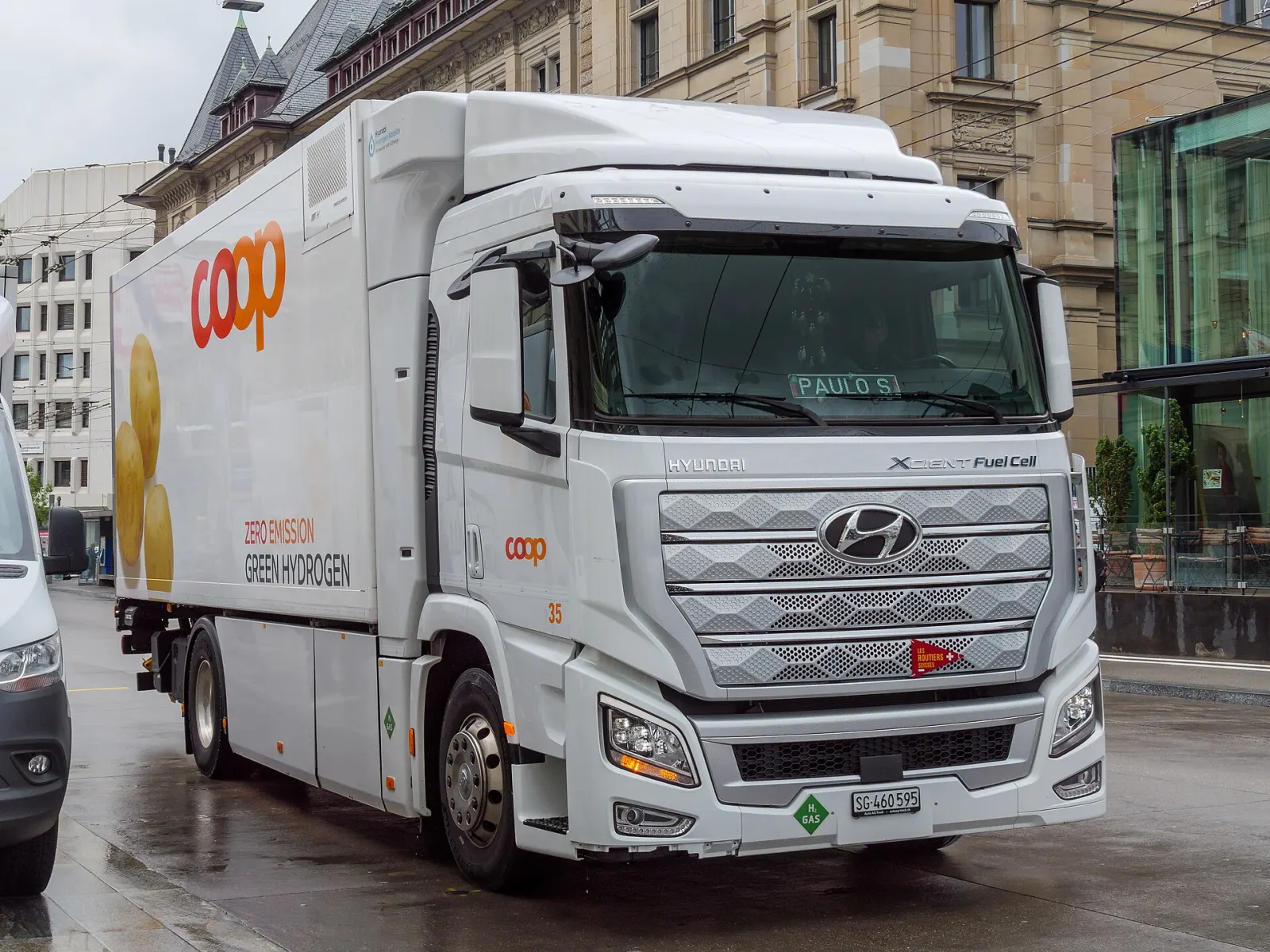
What has actually been proven
Hyundai Motor Group announced in February 2026 that its XCIENT Fuel Cell Class-8 fleet had passed 20 million kilometres across Europe — 165 trucks running in Switzerland, Germany, France, the Netherlands and Austria over five years. The Swiss deployment that started it in October 2020 uses two 90 kW fuel-cell systems (180 kW combined) feeding a 350 kW drive motor, with a rated range beyond 400 km; by mid-2024 that fleet alone had logged 10 million kilometres on 48 trucks. In North America, Hyundai reports 63 units and roughly 1.6 million kilometres since their 2023 debut. Nothing in that record suggests the powertrain is the weak link. These are ordinary distribution and regional duty cycles, run commercially, through five winters, with fleet operators who kept renewing.
The number that frames everything
Now set the kilometres against the parc. A February 2026 European Parliament transport committee background paper on AFIR implementation counts around 22,500 battery-electric trucks registered in the EU — and 242 hydrogen trucks. On the supply side, roughly 320 hydrogen refuelling points are operational EU-wide, against the approximately 650 the regulation implies will be needed by 2030. AFIR itself (Regulation (EU) 2023/1804) requires a publicly accessible hydrogen station at least every 200 km along the TEN-T core network by 31 December 2030, each designed for a cumulative capacity of one tonne per day with at least a 700-bar dispenser. Hydrogen is not losing the heavy-truck race on reliability or kilometres driven. It is losing it, roughly 90 to one, on trucks bought.
The manufacturers died; the trucks didn't
Nikola filed for Chapter 11 on 19 February 2025 with about US$47 million of cash on hand, telling the court it would run limited service and HYLA hydrogen fuelling only to the end of March. Hyzon — which four years earlier had promised 40,000 trucks in 2025 — had its stockholders approve an assignment for the benefit of creditors and a plan of dissolution in March 2025, having cited the inability to raise capital and uncertainty over California's zero-emission truck voucher scheme. Both carried the same structural flaw: each had to sell the vehicle, build the fuel network and absorb the subsidy risk simultaneously. Hyundai's Swiss model inverted that — trucks supplied on a pay-per-use basis into a hydrogen ecosystem that already existed, with fuel and vehicle bundled by parties who owned both ends.
The energy chain is the honest problem
The IEA's Global Hydrogen Review 2025 is blunt about it: heavy trucks are the only fast-growing market for fuel-cell vehicles, and they are growing despite a higher total cost of ownership than either battery-electric or diesel equivalents. Almost 95% of the world's fuel-cell commercial-vehicle stock sits in China, sustained by policy rather than by freight economics. The physics behind that cost is not going to be engineered away: every kilowatt-hour passes through electrolysis, then compression or liquefaction, then distribution, then a fuel cell, and each conversion discards energy a battery truck simply keeps. Hydrogen buys back payload and refuelling time; it pays for that in energy per kilometre, and unlike cell cost, that penalty does not fall with production volume.
What the Swiss case actually shows
The Swiss fleet's business case was never purely technical. Switzerland's distance-based heavy vehicle charge, the LSVA, does not currently apply to electrically driven trucks — a material per-tonne-kilometre advantage on a levy explicitly designed to push freight onto rail. That advantage is being withdrawn: the Federal Council adopted a message to parliament on 28 May 2025 to bring electrically driven trucks into the LSVA from 2029, with a discount regime running to 2035 so operators who have already bought zero-emission fleets keep some planning certainty. It is the general rule for zero-emission haulage stated plainly. The business case is a policy instrument with a technology attached, and policy instruments get revised on a legislature's timetable, not a truck's depreciation schedule.
Australia's version of the problem
Australia has one commercially operated hydrogen refuelling station purpose-built for heavy vehicles: the Coregas H2Station at Port Kembla, opened in 2023 for about $2 million including a $500,000 NSW government grant, deliberately sited beside Coregas's existing hydrogen production plant inside the BlueScope terminal. It compresses hydrogen to 500 bar to fill 350-bar onboard cylinders, holds around 400 kg of fuel-cell-grade hydrogen and can service up to ten vehicles a day. Note the pressure: 350 bar, where Europe is standardising on 700-bar dispensing — a fragmentation that quietly constrains which trucks can be imported and how far they go per fill. Upstream, the domestic supply thesis has thinned: Fortescue told the ASX in July 2025 that its Arizona Hydrogen and Gladstone PEM50 projects would not proceed, flagging a pre-tax write-down of about US$150 million.
Where hydrogen still pencils
The surviving case is narrow, but it is real. Mass- and volume-critical work where battery weight eats paying payload; remote and regional routes where corridor charging will not exist this decade; and captive fleets that already produce or move hydrogen — which is precisely why an industrial gas company, not a general carrier, is Australia's hydrogen-truck pioneer. Those operations share one trait: hydrogen is a by-product of something the business already does, so the fuel price is an internal transfer rather than a retail exposure. For an operator buying merchant hydrogen at a public dispenser and paying full freight for compression and delivery, the arithmetic still does not close without a subsidy, a road-user-charge exemption, or a client willing to pay a premium for the abatement.
What an operator should do about it now
Do not run a hydrogen trial as a technology decision; run it as a measurement exercise, and run it on the diesel fleet you already have. Instrument the duty cycles you would actually replace: kilometres by route, payload actually carried rather than rated, dwell at each stop, the true length of the refuelling or rest window, and the share of trips that fall outside a single tank or a single charge. Most fleets that do this discover that 70 to 80 per cent of their task sits inside battery range and depot charging windows, and that the residual — the heavy, remote, mass-critical remainder — is the only honest candidate for hydrogen. Both conclusions depend on the same prerequisite: per-vehicle records good enough to survive a finance review.