 SITELIVE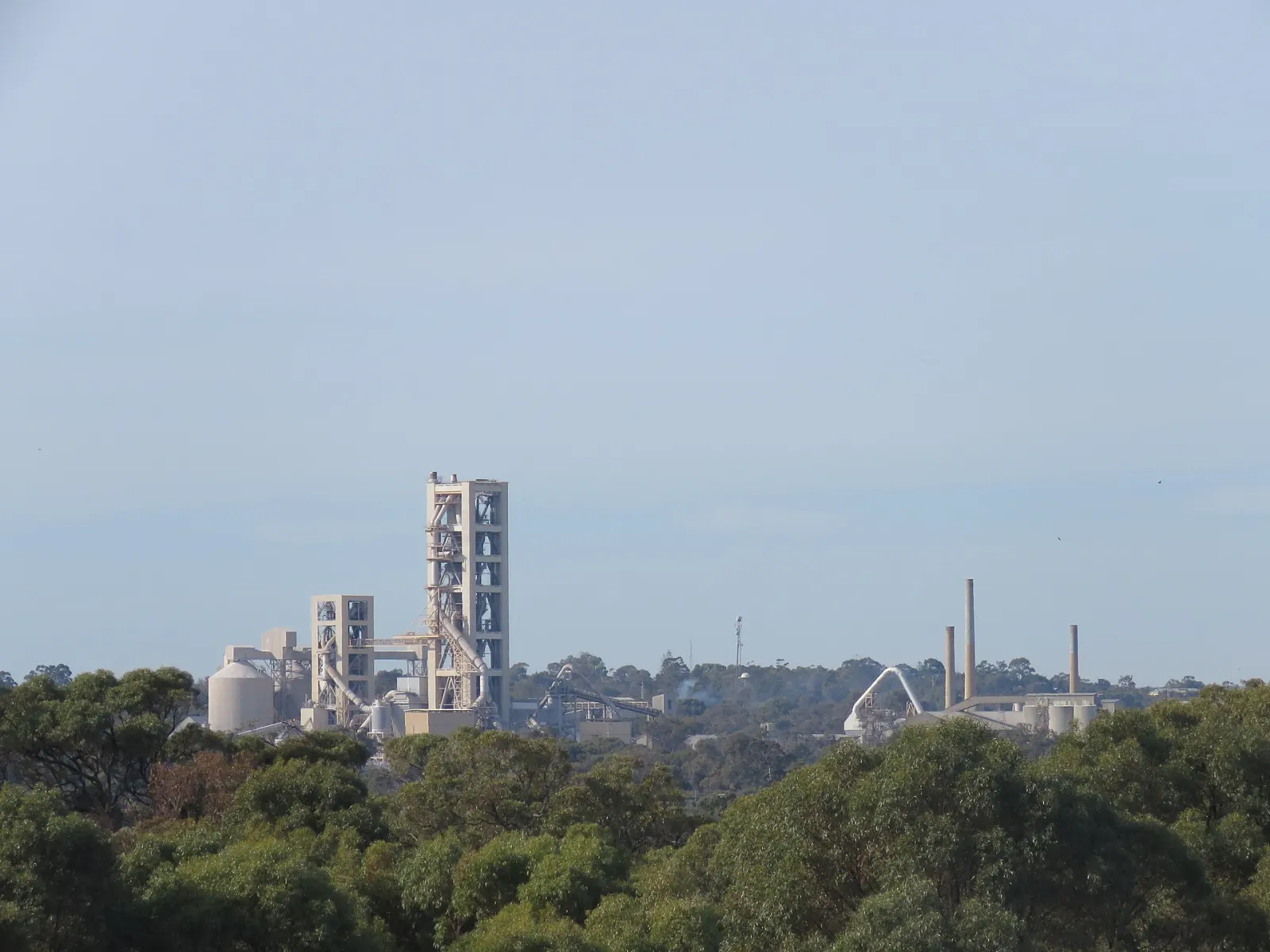
Why heat is the hard part
Industrial heat accounts for about a quarter of global final energy use, on Rondo Energy's figures, and in Australia process heat represents more than half of industrial energy use — almost entirely supplied by natural gas and coal, according to the ARENA-funded knowledge sharing report from MGA Thermal's demonstration project. For construction the exposure is direct, because cement, lime, alumina, glass, bricks and steel are all heat businesses before they are anything else. Cement and lime carry a second problem that electrification does not touch: calcining limestone releases CO₂ from the rock itself, whatever supplies the heat.
Heat batteries are past the demonstration stage
Rondo Energy started commercial operation of a 100 MWh heat battery in October 2025 — refractory bricks charged by resistance heating, storing above 1,000°C and discharging as high-pressure steam. It is powered exclusively by an on-site solar array, delivers heat 24 hours a day, and after ten weeks of automatic operation Rondo reports round-trip efficiency above 97%, feeding steam alongside the facility's existing gas-fired boilers without process changes. The design logic is economic rather than thermal: the unit charges during only the six cheapest hours of electricity a day and discharges continuously, which is how intermittent renewable power is made to behave like firm heat.
Australia's own data point, with the numbers published
MGA Thermal's demonstration plant at Tomago, NSW, funded by ARENA under the Advancing Renewables Program, packed 3,712 miscibility-gap-alloy blocks into a 5 MWh store charged by a 500 kW electric heating system and discharging superheated steam at 365°C and 37 bar, in a unit roughly 20 metres long on a 72 m² footprint. The final knowledge sharing report, published in October 2025, records a ten-hour discharge test and concludes the modular architecture scales directly to the 50–200 MWh range. Note what that is and is not: 365°C process steam serves food, chemicals, refining and light manufacturing. It is nowhere near a cement kiln.
Calcination is the 900°C problem
Leilac, the technology subsidiary of ASX-listed Calix, attacks the harder end. Its calciner heats the raw material indirectly through a modular array of engineered steel tubes, so the CO₂ released by the limestone comes off as a high-purity stream rather than being separated from flue gas afterwards — and because the heat source is separated from the reaction, it can be supplied by fuel, biomass, hydrogen or electricity. Its commercial position shifted in June 2026: a joint development agreement with Adani Group's Ambuja Cements in India, and a paid engineering study with an unnamed East Asian cement producer targeting roughly 100,000 tonnes a year of process CO₂. Both are structured to require no capital from Leilac or Calix.
The alternatives being tried in parallel
In Gladstone, Rio Tinto and Summit Hydrogen Gladstone, a Sumitomo subsidiary, are building a A$111 million hydrogen calcination pilot at the Yarwun alumina refinery with ARENA and Central Queensland Hydrogen Hub support: a 2.5 MW electrolyser supplying more than 250 tonnes of hydrogen a year, one of the refinery's four calciners retrofitted with hydrogen burners, and four tonnes of on-site storage — enough to run that calciner on 100% hydrogen for two hours, which Rio Tinto describes as the minimum window needed to de-risk full-scale operation. Construction began in 2024 and Rio Tinto expects the plant operational in the second half of 2026. The other route is capture rather than substitution: Heidelberg Materials opened Brevik CCS in Norway in June 2025, the cement industry's first industrial-scale capture facility, taking about 400,000 tonnes of CO₂ a year — half the plant's emissions — into the Northern Lights storage chain and enabling its evoZero cement.
The project that was cancelled, and why it matters most
The most useful public document in this field is a failure report. Alcoa's mechanical vapour recompression project at the Wagerup alumina refinery, backed by A$11.3 million from ARENA, ran from March 2021 and was terminated in November 2023 after detailed design: the close-out report states it was found financially unviable because it no longer met its objective of a low-capital form of evaporation. The physics of electrifying refinery steam was never in doubt; the capital cost was. Leilac's June 2026 update is candid in the same way — projects that do not expect to be fully funded are de-prioritised until a customer or external funding, and a clear route to commercial operation, appears. Anyone claiming industrial heat electrification is merely a matter of will should be asked for the final investment decision and the capex per tonne of steam.
The forcing function, and what it means for buyers
The pressure is regulatory and largely unhedged. Under Australia's reformed Safeguard Mechanism, facility baselines decline 4.9% each year to 2030 — trade-exposed baseline-adjusted facilities can be approved for rates as low as 1% — with post-2030 rates set in five-year blocks. Producers are responding with fuel switching well before electrification: in December 2025 the NSW government granted A$25.45 million to Boral's Berrima works, the state's only integrated cement plant and the source of more than half of NSW's cement, for kiln upgrades enabling up to 60% of its energy to come from non-coal sources, a projected lifetime reduction of about 1,586,200 tonnes CO₂e and 73,000 tonnes of waste diverted from landfill each year. That is the mechanism by which cement's carbon number and its price will actually move: kiln by kiln, not brand by brand.
What a contractor should do with this
Practically, three things follow. Expect cement and lime supply to differentiate by plant rather than by supplier, so specify and record the works of origin, not just the product name. Expect fuel-mix and EPD questions to migrate from tender documents into supply contracts, with penalties attached, as Safeguard baselines tighten each July. And treat any supplier's decarbonisation timeline the way you would treat a subcontractor's programme — ask what has reached final investment decision, what is funded, and what is still an engineering study. On this evidence, the gap between those categories is where most of the industry currently sits.