 SITELIVE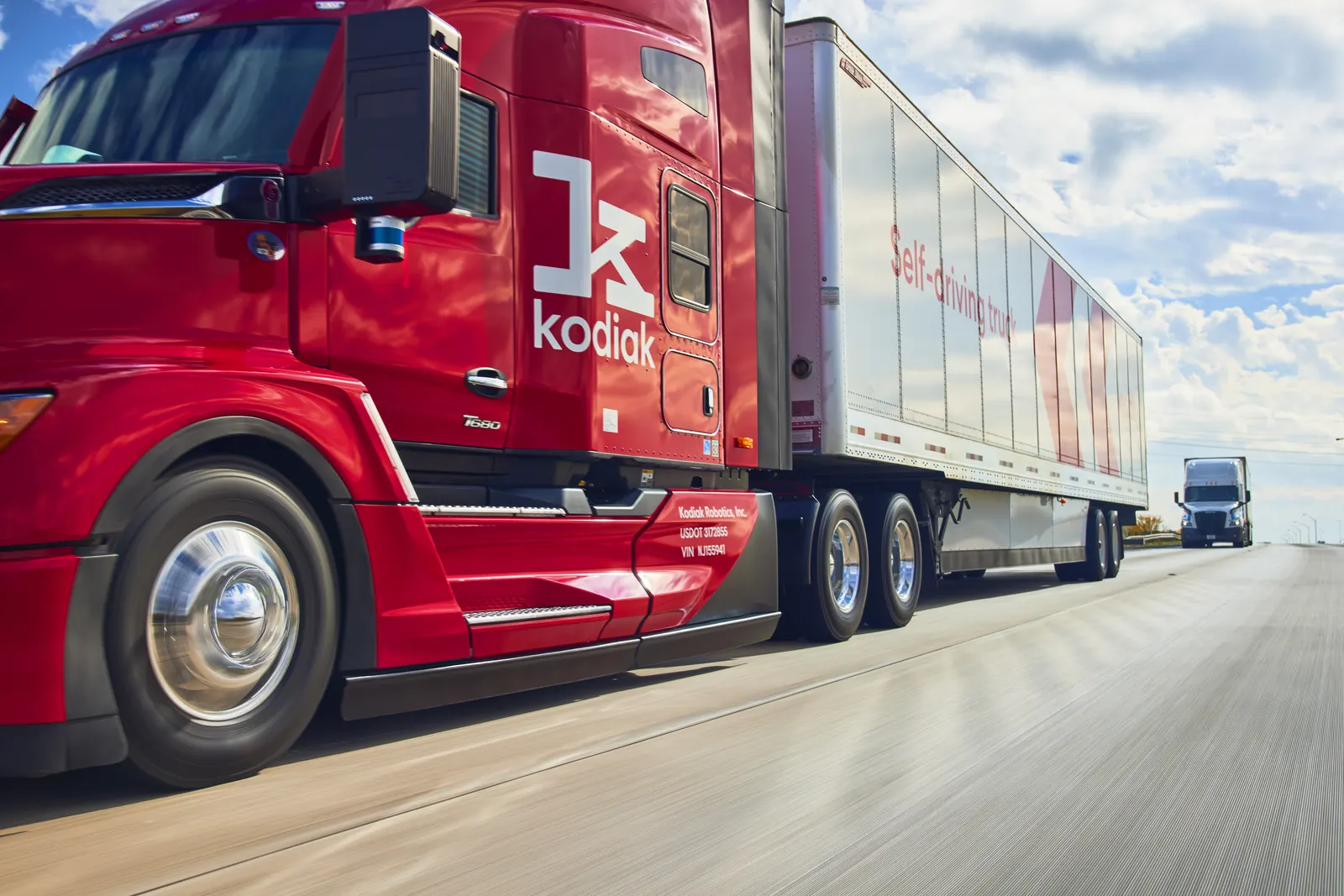
What the two companies announced
On 26 August, Kodiak AI (Nasdaq: KDK) and AMD said AMD EPYC processors will power Kodiak’s seventh-generation autonomous truck platform. Kodiak describes itself as the first company to deploy the advanced AMD EPYC processors into a hardware platform for driverless trucking; AMD puts the same claim as the first autonomous trucking company to deploy advanced EPYC processors. Inside the Gen7 Kodiak Driver, the CPUs aggregate sensor data, preprocess the output of the LiDARs, cameras and radars in Kodiak’s SensorPods, and carry localisation, path planning and what AMD calls timing-sensitive general-purpose processing — the work that decides where the truck goes next.
The hardware detail AMD published is narrow and useful: the platform gets 80 PCIe lanes, a 3.15 GHz base frequency and a maximum boost of up to 4.4 GHz, which AMD states is 25 per cent higher clock speed than the previous generation device. Kodiak adds that faster clocks at lower power consumption let it process critical data more quickly. Wayne Lyons, AMD’s senior director for the automotive market, framed it as moving driverless trucking from innovation to significant scale; Don Burnette, Kodiak’s founder and chief executive, said EPYC delivers the performance, scalability and efficiency needed to keep commercialising the Kodiak Driver. Kodiak also repeats its current operating position: a growing driverless fleet in the Permian Basin already running with nobody in the cab, and driverless trucks on public highways as a target for later this year.
Why the reasoning behind the choice is the interesting part
The technically substantive sentence in AMD’s post is the justification, not the specification. Key autonomous-driving CPU workloads — sensor processing, localisation, path planning — are latency-sensitive and cannot easily be parallelised. That is a direct rebuttal of how autonomy compute is usually sold. The public conversation is denominated in TOPS and accelerator counts, which measure how much parallel inference you can do per second. It does not measure how quickly a single dependent chain of work can complete, and a truck at highway speed is governed by the chain: aggregate the frame, fuse it, localise, plan, actuate, in order, every cycle. When the chain is serial, the lever is clock frequency and the I/O to get data off the sensors and into memory without waiting — which is exactly what 80 lanes and a 4.4 GHz boost buy.
Choosing a commercially available server-class part rather than a custom SoC is also a deliberate commercial position, and Kodiak says so plainly: using leading, commercially available hardware lets it spend its own engineering on production-ready trucks. For a fleet, that trade has a real upside beyond development speed. Merchant silicon means a documented part with multiple channels, published lifecycles and a repair path that does not run through a single autonomy vendor’s inventory. A bespoke compute module is a single-source dependency for the life of the truck.
It also lines up with where the constraint actually sits. Kodiak’s own Q2 disclosure described the Gen7 platform as more compact than Gen6 with nearly 50 per cent more compute, and — the more telling number — nearly 50 per cent greater expected operational lifetimes for its SensorPods and compute enclosures under stress testing, including a lower-cost day-cab configuration. Compute per truck is not what is holding driverless freight back. Serviceable hardware life, upfit throughput and cost per truck are, and this announcement is aimed squarely at the third one.
The honest limits
Neither company names the processor. There is no SKU, no core count, no TDP and no measured power figure anywhere in either release, which leaves two of the headline claims unauditable: lower power consumption is stated without a watt, and the 25 per cent clock improvement is stated against a previous generation device that is never identified — so the baseline could be an earlier EPYC part or something else entirely. Nor is there a single latency number. No perception-to-actuation budget, no cycle time, no frames per second, no measured improvement in any of the operations the faster clock is said to accelerate. A CPU swap that is justified on serial latency and published without a latency figure is an engineering argument, not an engineering result.
The qualification question is unanswered too. EPYC is a server processor family, and putting one on a truck raises the ordinary vehicle-hardware questions — thermal envelope, vibration, ingress, supply life, and what functional-safety argument the compute sits inside. Neither release mentions a safety standard, a qualification programme or an automotive-grade variant. That is not evidence that the work has not been done; it is a gap in what has been disclosed, and it is the gap that matters most in a hot climate, because a part boosting to 4.4 GHz in a roof enclosure at Pilbara or Permian summer ambients is a cooling problem before it is a compute one.
And the scope is narrower than the framing. This is CPU only: what handles the neural-network inference alongside it is not described, so the announcement covers one layer of a stack whose other layers stay undisclosed. Kodiak’s driverless volume today is repetitive short-haul oilfield work, the easiest operating design available and deliberately chosen. Driverless operation on public highways remains a target for later this year, and Kodiak’s own release carries the standard forward-looking-statements caveat over that expectation. The compute is shipping. The service it is meant to enable is not.
What it means for operators
If you buy or host autonomous haulage, the useful reading of this announcement is that the vendor has made its compute a commodity you can ask questions about — so ask them. Which part is it, what does it draw, and what does the enclosure dissipate at your worst ambient. What is the rated service life of the compute unit and the sensor pods, and what is the spares lead time. Is the module field-replaceable at your workshop or does the truck go back to the integrator. What happens when that CPU generation goes end-of-life mid-way through a seven-year retrofit fleet. None of those are exotic questions; they are the same questions you would ask about a transmission.
The measurement discipline is the same as ever, and this release is a reminder of what to insist on. A compute upgrade should show up as something you can see in the record: interventions per hundred hours, remote-assistance events per shift, unplanned stops, availability, cycle time on the same route before and after. If the only evidence of an improvement is a clock speed, you have been given a datasheet and not a result. Baseline the route before the fit-out, keep the machine and shift records afterwards, and the difference becomes yours to prove rather than the vendor’s to assert.