 SITELIVE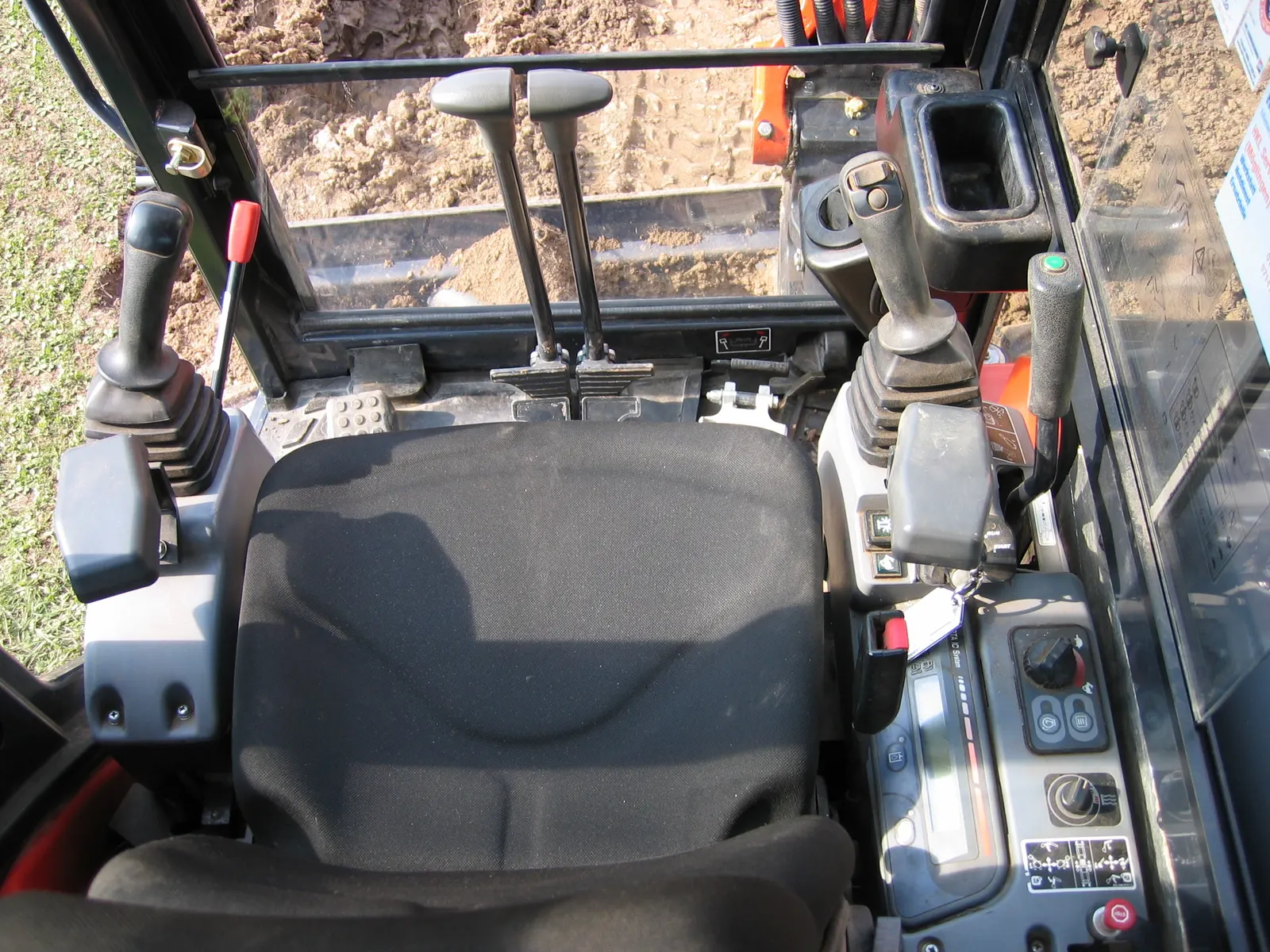
What they built
A team led by Hermano Krebs, a principal research scientist in MIT’s Department of Mechanical Engineering, built what they call a World-Space Interface: a miniature excavator arm and bucket that the operator grasps and moves as they would their own arm, with a virtual excavator on an immersive six-screen display mirroring the motion. The point is the mapping. A conventional excavator is driven through two joysticks that command individual joints — boom, stick, bucket, slew — which the operator must mentally coordinate into a smooth path through space. The miniature arm collapses that step: you move the tool where you want the tool to go. MIT’s co-authors on the work are Moises Alencastre-Miranda, Joao Buzzatto and Eran Beeri Bamani, with collaborators at Sumitomo Heavy Industries, a partnership that began in 2018 in response to Japan’s ageing heavy-machinery workforce. The results were published in the Journal of Computing in Civil Engineering.
What the study actually measured
The team built 15 virtual excavation environments — construction sites, highways, forest roads, riverbanks, mining areas, urban and rural settings — with tasks including scooping and dumping sand or gravel, digging and grading trenches, clearing debris from roads, removing tree branches from the edge of water, and breaking up rocks, arranged in increasing difficulty to resemble a weeklong excavator driving course. Volunteers, both experienced operators and novices, trained one hour a day for seven days on both the World-Space Interface and a joystick-based simulator, and the researchers compared performance before and after. The headline finding is a difference in starting point, not just improvement: on the joystick simulator, novices were consistently worse than the experts throughout, though they improved; on the World-Space Interface, novices performed as well as the experts from the start. Krebs describes potential uses beyond training — a miniature arm in the cab as an alternative to joysticks, or teleoperation from a trailer away from the machine. Adding haptic force feedback is described as future work, and the study was supported in part by Sumitomo Heavy Industries.
The honest limits
Everything measured happened in simulation. A virtual excavator on a six-screen display is not a 35-tonne machine loading a truck on a wet batter: there is no track slip, no boundary layer of hydraulic lag, no risk, no dust, no spotter, and no consequence for a mistake. MIT’s announcement reports no field validation on a real machine, and the participant counts and effect sizes live in the paper rather than the release — we could not load the journal page to read them, so treat “as good as the experts” as the direction of a published finding, not as a quantified margin. Force feedback, which the team names as the next development, is not a nicety: breakout force, bucket fill and ground reaction are precisely the cues an experienced operator reads through the machine, and an interface without them is missing the channel that separates competent digging from fast digging. The work was also funded in part by a machinery manufacturer, which does not make it wrong but does mean it is not an independent evaluation.
And “as good as an expert” is scoped to the tasks in the study on that interface. It does not mean site-ready. Nothing in a simulator teaches trench support and ground conditions, service location and spotting, batter angles, machine pre-starts and care, working near live traffic or overhead lines, or the load-out coordination that actually determines whether a dig runs. In Australia, that gap has a regulatory shape: excavator operation is not a high-risk work licence class under Schedule 3 of the model WHS Regulations, so there is no certificate to hide behind — the employer verifies competency, and a simulator result of any kind does not discharge that duty on the specific machine, on the specific site.
What it means for operators
The practical value of this result is diagnostic rather than commercial. If a novice on a world-space controller matches an expert immediately, then a large share of the years spent “learning to run an excavator” is being spent learning the interface, not the craft — and the craft is the part worth paying for. That reframes how a contractor should think about its own operator pipeline: separate what a trainee is failing at. Poor control coordination is an interface and hours problem. Poor judgment about ground, grade, sequence and safety is a supervision and knowledge problem, and no amount of simulator time fixes it. Most training plans conflate the two and then measure neither.
The nearer-term prize is the same one that makes the result interesting: teleoperation and in-cab alternatives for repetitive work, which is where a more intuitive controller would pay first. If you run simulators today, the useful discipline is to record what was trained, in what environment, with what assessment result, and then record the verification on the real machine separately — because when a competency question is asked later, whether by a regulator, a client or an insurer, “we did some sim training” is not an answer and a signed verification against named tasks is.