 SITELIVE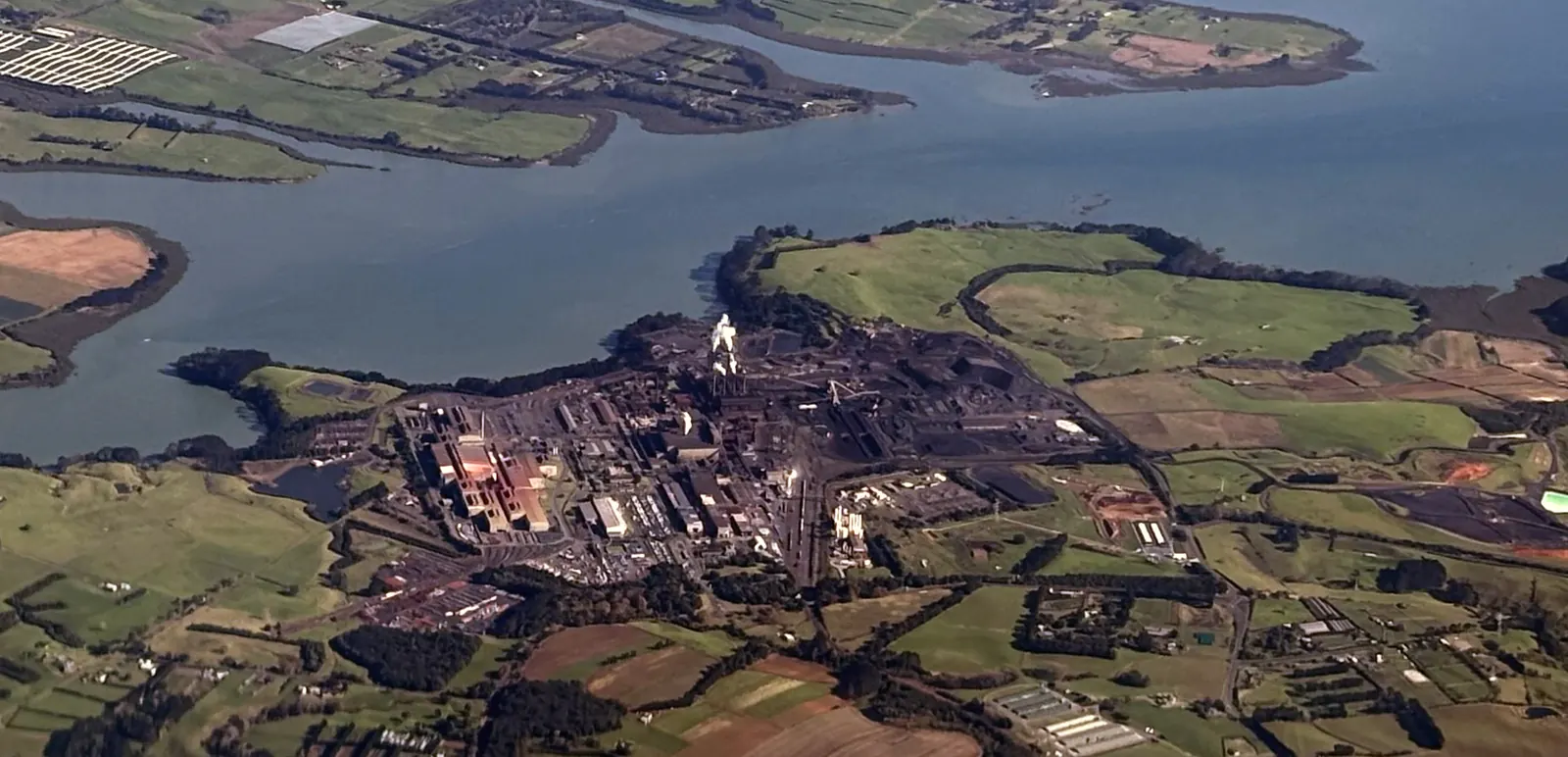
What happened
New Zealand Steel has announced its first commercial steel production from the new electric arc furnace at the Glenbrook steelworks, 60km south of Auckland, just over two years after breaking ground in June 2024. The company — the country's only producer of flat rolled steel for infrastructure, construction, manufacturing and agriculture — says the transition cuts the steelworks' annual greenhouse gas emissions by more than 45 per cent, and that it has been carried out inside a fully operational plant while continuing to produce the usual 650,000 tonnes of steel a year to keep domestic supply uninterrupted. Chief Executive Australia and New Zealand Robin Davies said the project "has exceeded a million hours of construction effort to get us to this point today".
Physically, the change is a substitution at the front of the process: the EAF replaces Glenbrook's oxygen steelmaking furnace and two of the site's four coal-fuelled kilns, halving coal use at the site, and melts locally collected scrap using renewable electricity instead of converting all of the plant's ironsand feed with coal. The supporting commercial structure is as much of the story as the furnace — the New Zealand government co-investing up to $140 million through its GIDI decarbonisation fund, a firmed renewable electricity supply agreement with Contact Energy, and long-term scrap supply agreements with Sims and GMS that divert hundreds of thousands of tonnes of scrap from export into domestic recycling at Glenbrook. Sister company Pacific Steel will bring the product to market first, with PACIFIC becoming the standard grade later this year and PACIFIC DCRB positioned as a lower-carbon reinforcing steel.
Why "inside a live plant" is the engineering headline
Anyone who has staged works inside an operating facility will recognise what the schedule actually required. This was not a greenfield furnace commissioned on an empty pad; it was a new melting route tied into existing rolling, coating and logistics, with the old oxygen steelmaking furnace and two kilns retired, on a site that had to keep delivering coil and reo into a market with no domestic alternative. Two years from ground-break to first commercial heat, with output held at 650,000 tonnes a year through the transition, is a brownfield programme result, and brownfield is where almost all industrial decarbonisation will have to happen.
The electricity arrangement is the other transferable detail. The government's announcement of the deal describes a demand response arrangement with Contact Energy under which NZ Steel can scale down its grid draw when supply needs to be secured regionally at peak times. That is a heavy industrial plant contracting to be flexible, not just to be supplied — the trade that makes large electrification loads acceptable to a constrained grid. For Australian operators watching electrification of process heat, it is the model to study: the furnace is the easy part of the sentence, the firmed-and-flexible supply agreement is the hard part.
The honest limits
The claims worth separating from the facts. "Some of the world's lowest carbon steel" is the company's framing, and the release publishes no product-level carbon intensity figures and no environmental product declaration to check it against; likewise PACIFIC DCRB is described as setting a benchmark for locally made reinforcing steel without a published number attached. The more-than-45-per-cent reduction is a site-level annual emissions figure for the steelworks, not a per-tonne product intensity, and site-level reductions and product declarations are not interchangeable in a tender. Coal has not left Glenbrook: two of the four kilns remain coal-fuelled and the ironsand-based route continues alongside scrap melting — coal use is halved, not eliminated. The government co-investment is "up to" $140 million, and the emissions-budget contributions cited when the deal was struck — 5.3 per cent of the reductions needed under New Zealand's second emissions budget and 3.4 per cent of the third — were official estimates made at announcement, not measured outcomes.
Two structural dependencies also deserve stating plainly, because they set the ceiling on this kind of project. An EAF route depends on scrap: quality, price and continuity of supply from Sims and GMS now sit on the critical path where coal and ironsand used to, and scrap chemistry constrains which grades can be made. And it depends on electricity that is both renewable and firm, in a hydro-dominated system with dry-year risk — which is precisely why the demand response clause exists. Neither is a criticism of the project; both are the reasons a first commercial heat is a milestone rather than a finish line.
What it means for specifiers and contractors
If you buy steel in New Zealand, the practical change arrives later this year when the lower-carbon product becomes the standard grade rather than a premium option — which means the embodied carbon figure in your next project's materials schedule can move without you specifying anything unusual. To use it, ask for the evidence in the form a client or a rating scheme will accept: a current product-level EPD with the declared unit and system boundary, the mill certificate for the heat you actually received, and the date the declaration was issued. A site-level "45 per cent lower emissions" line in a supplier's brochure is not substantiation for an embodied carbon claim in a tender or a Green Star submission; a product declaration is.
For Australian contractors and fabricators, the read-across is supply and substitution risk rather than immediate opportunity. Scrap that used to be exported is now being pulled into domestic recycling at Glenbrook, which tightens one regional feed while adding a lower-carbon flat-rolled and reinforcing source across the Tasman. If your specifications name a mill or an origin, check whether they still describe what you can actually get, and whether your carbon reporting is set up to record the product declaration for each delivery rather than an annual supplier average.