 SITELIVE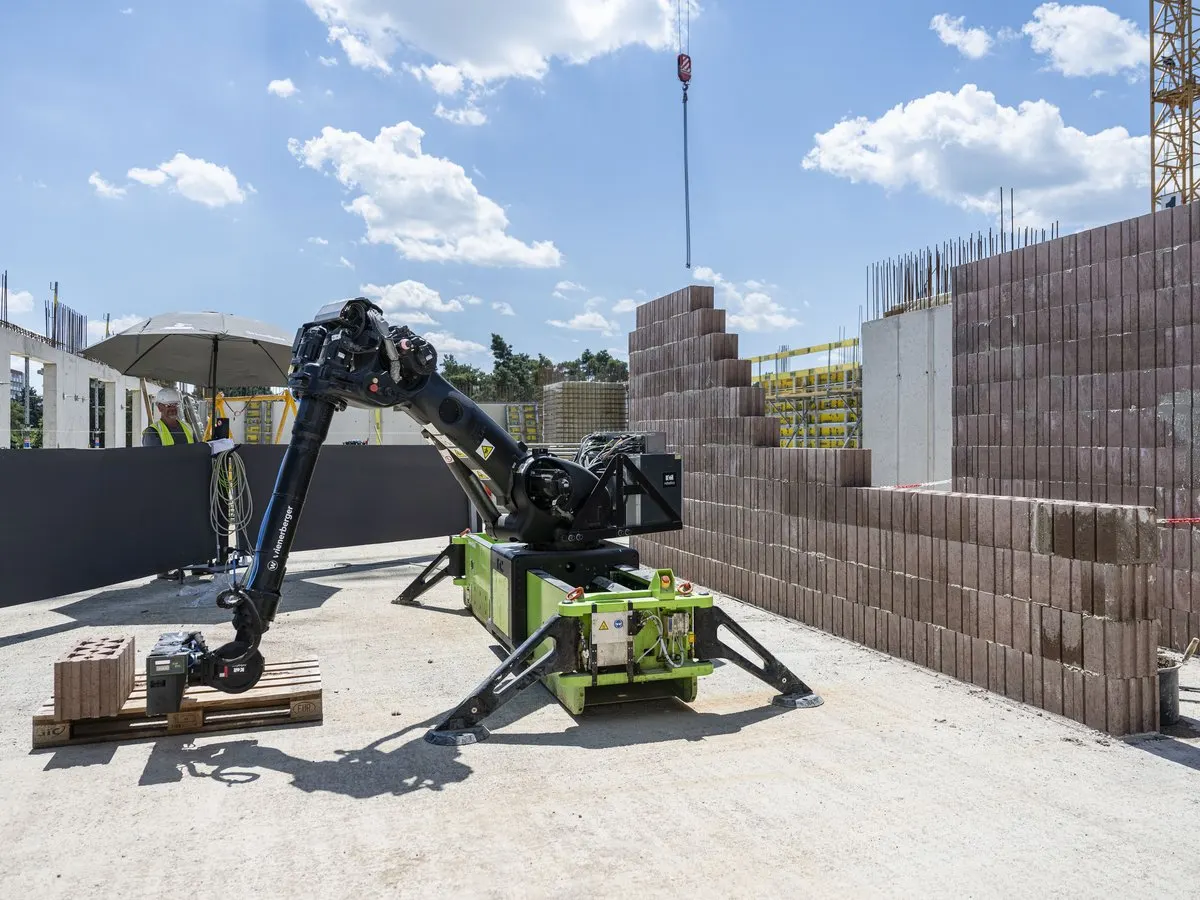
What is actually on site
PORR announced on 6 August 2026 that a bricklaying robot known as WLTR — "Walter" — is building load-bearing walls and apartment partition walls on the Kladno Living residential project near Prague, a five-building scheme of 371 apartments with covered parking. The walls are laid in precision-made acoustic bricks, positioned, PORR says, with millimetre precision from the digital project model. The company has been testing the machine since 2025 to assess practical suitability under real construction site conditions; on Kladno Living it has been part of the process since the project started.
PORR published the machine’s numbers, which is rarer than the robot itself: 2,500 kg, a 3.5 m working range, productivity of 7.5 m²/h with a maximum of 10 m²/h, bricks up to 52 kg, two operators, and power consumption of 1.5 kW — less, as the release points out, than a common kettle. The current generation is not restricted to long straight runs: PORR says it also executes corners and wall openings.
The productivity line is the story
The sentence worth stopping on is PORR’s own assessment: the experience from Kladno Living shows the robot "is currently achieving productivity comparable to that of an experienced bricklayer". A vendor would have found a bigger number. A contractor reporting on its own pilot published the flat one, and then said where the value actually sits: "its greatest benefit lies in taking on the most physically demanding activities, such as lifting and moving heavy construction materials", at consistent quality. With bricks up to 52 kg, that is a manual-handling problem being engineered out, not a labour cost being engineered away — and PORR’s CEO Karl Heinz Strauss says so directly: "Construction is and will remain a people business. Our aim is not to replace people, but to provide our employees with tools that make particularly heavy work easier for them."
The honest limits and economics
At parity productivity, the machine has to pay for itself somewhere other than speed, and PORR is clear about the overheads. The robot works under the supervision of trained specialists, needs careful construction site preparation and sufficient room to move, and its use requires close coordination between planning, structural engineering, the client and the site team, plus specific site planning and logistics. Two operators are part of the published spec. Nothing in the release quantifies capital cost, hire rate, mobilisation time, set-up time per wall, or the share of the project’s walls Walter is laying — and 7.5 m²/h is an instantaneous rate, not a shift output, so it says nothing about how many hours a day the machine is actually laying. Kladno Living is described as a pilot project; PORR is not claiming a settled commercial case for it.
It is also a masonry-specific machine, in a market — precision-made acoustic block, laid from a digital project model — where the substrate is already engineered for automation. That is the pattern across construction robotics: the robot arrives after someone has standardised the material and the model. The robot is the last 10 per cent of that change, and the cheapest part of it.
What it means for builders
Two practical reads. First, judge these machines on the injury and quality ledger before the productivity one. If a robot removes the repeated 52 kg lift from a crew’s day, the return shows up in claims, absence and the ability to keep experienced bricklayers working into their fifties — none of which appear in an m²/h figure. Second, the enabling work is programme work, not robotics: model discipline, deliveries of a single brick spec, a floor swept and set out early, and a crane plan that gives the machine room. Contractors who lose money on robot pilots usually lose it on set-up and standing time, not on lay rate. Log both from day one, per wall, so your second job prices the machine off your own numbers instead of a brochure.