 SITELIVE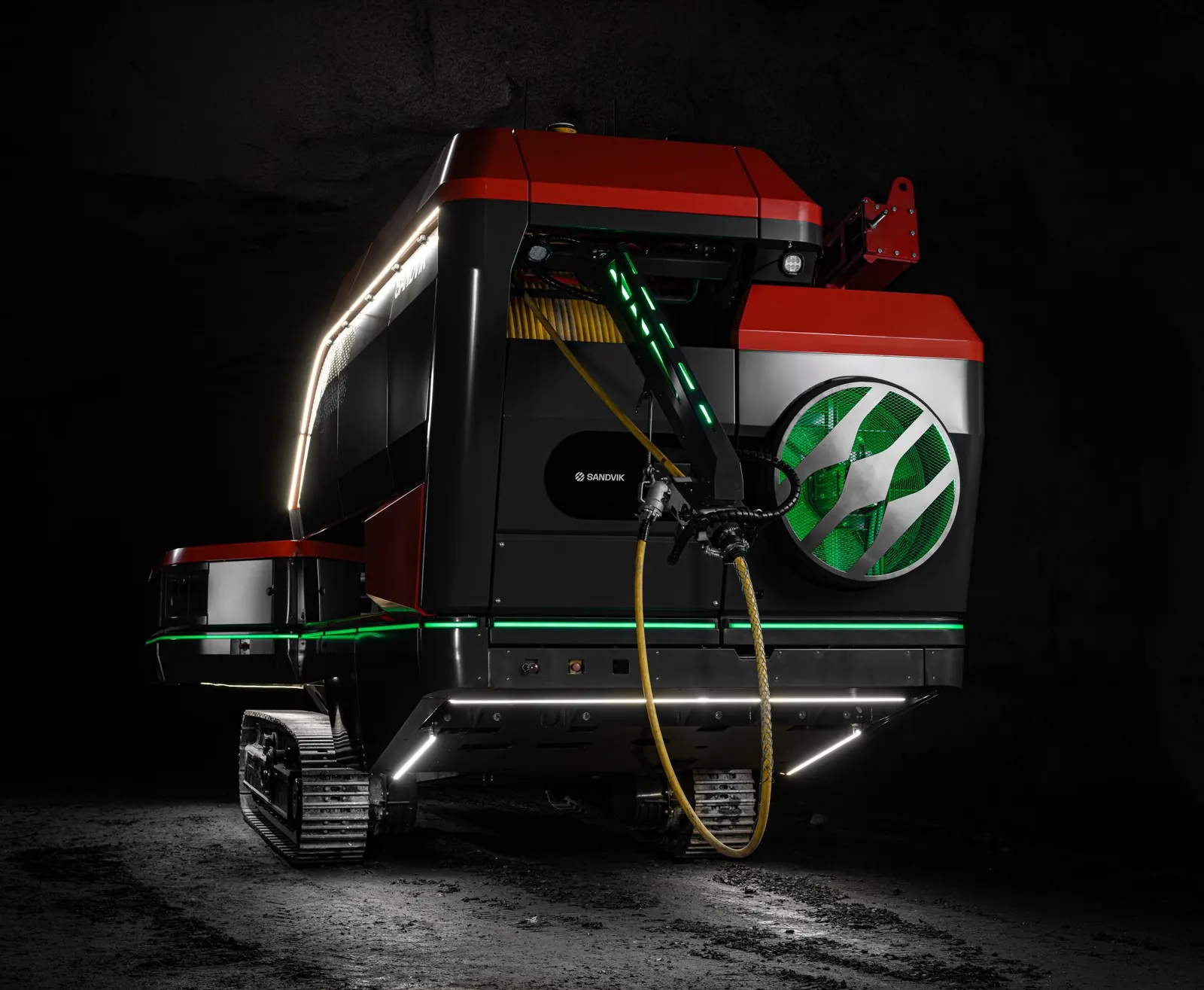
What was shown
Sandvik’s concept machine, described in a Solid Ground feature published on 31 August and shown at the company’s Surface Test Pit during Future of Mining 2026, is built on a boom-drill platform, is battery-electric with the option of tethered electric drilling, and has no operator cabin. It carries its own drill bits, collar pipes and down-the-hole hammers, and an integrated industrial robot performs bit changes, installs collar pipes and replaces hammers without a person on the deck. After drilling it measures hole depth and deviation. It navigates itself between holes and around the pit, identifying, tracking and classifying people, equipment and other objects so that it can tell a moving obstacle from a stationary one; LED matrix displays on the machine show its status to anyone nearby.
The part Sandvik is most keen to talk about sits above the machine. The concept is connected to a continuously updated, mine-wide digital twin, and Sandvik’s AI agent assigns it drilling tasks and coordinates activity across the wider fleet. Operators talk to the agent in natural language — ask a question, assign a task, check status — and are alerted when human judgement is needed. The machine then starts itself, plans its route and drilling, executes the cycle and writes the result back to the twin. Riku Pulli, Sandvik’s President of Digital Mining Technologies, put the claim precisely: “By combining AI, autonomy and a continuously updated digital twin, we move from optimizing individual assets to optimizing the entire mining operation.” He also said, in the same piece, that “the machine is a concept rather than a product, but the technologies behind it are very real.”
Why the bit changer is the part that matters
Strip away the persona and the agent and the concept does one thing that surface drilling has struggled to automate: it removes the human from consumable handling. Underground, Sandvik and others have been running teleremote and autonomous loaders and trucks for years; on surface blasthole rigs the operator has stayed in the cabin partly because someone has to go out to the deck to change a bit, add a collar pipe or swap a hammer, and that walk is where the pinch points and the dropped tools are. A rig that carries its own consumables and changes them robotically can, in principle, run a full pattern unattended, which is the precondition for one control-room operator supervising several rigs.
That is also why Epiroc’s release is the more immediately useful of the two. Its Automatic Bit Changer for DTH applications is now available for Pit Viper 271, 275, 271 E and 275 E rigs configured for down-the-hole drilling. It lets the operator make and break joints, select a bit and complete the change from the cabin, or from the control room when the rig is running remotely or autonomously; it stores up to four bits so the operator can switch bit type as ground conditions change, and it sits above the deck for maintenance access. Epiroc’s Carla Chaname says the bit changer “has already proven its value in rotary drilling” and that the DTH version brings the same benefits to that method. The intent is stated plainly: eliminate live work during bit changes. That is a product with a part number, not a demonstration.
The honest limits
Sandvik says, repeatedly and to its credit, that Sami is a concept. No price, no availability date, no customer trial, no production figures and no autonomous-hours count have been published. The capabilities were demonstrated at Sandvik’s own Test Pit in Finland and at its own event in Tampere, which is the right place to prove a concept and the wrong place to draw conclusions about a Pilbara or Andean pit in a dust storm. The digital twin and the AI agent are described functionally, not with any published accuracy, latency or failure-mode data; “alerted when human judgment is required” is a design intent whose value depends entirely on how well the system knows what it does not know.
The concept is on a boom-drill platform — the smaller, top-hammer/DTH class of surface rig used in quarries and construction as much as in mining — and Sandvik says the technologies are intended to scale to its rotary blasthole drills. Intended is the operative word; rotary rigs handle heavier pipe and larger bits, and the robotics are not demonstrated at that size yet. On power, Sandvik says the concept “combines the flexibility of battery-electric operation with the power and endurance of tethered electric drilling”, which is an acknowledgement that a battery alone is not yet expected to carry a full drilling shift; no battery capacity, tether arrangement or shift duration has been published.
Epiroc’s release has the opposite problem: it is a real product but a narrow one. Four bits on board is a shift’s worth of options, not a week’s; the operator is still in a cabin unless the mine has already invested in Epiroc’s remote or autonomous drilling stack; and the release publishes no utilisation or cycle-time figures for DTH, only the assertion that they improve. Neither company has published a safety statistic for bit-change incidents that would let a reader size the hazard being removed.
What it means for operators
If you run blasthole rigs, the practical question this week is not whether to buy a cabinless robot but whether your bit-change and pipe-handling steps are the reason your rigs cannot run unattended. If they are, an above-deck bit changer on an existing rig is a bounded retrofit with a clear safety case, and it is the same first step that the concept machine takes. The sequence the OEMs are implying — automate the consumable handling, then remove the cabin, then hand scheduling to a fleet-level system — is a sensible one to copy even if you never buy from either of them.
The other thing worth taking from Tampere is what the AI agent is actually fed. Sandvik’s architecture only works because the rig measures its own hole depth and deviation and writes it to a twin that everything else reads. A drill pattern where as-drilled position, depth and deviation are captured per hole and reconciled against design is valuable on any site, autonomous or not; it is what makes the blast engineer’s job, the survey team’s job and the next shift’s decisions defensible. The agent is a user interface over that record. The record is the asset.