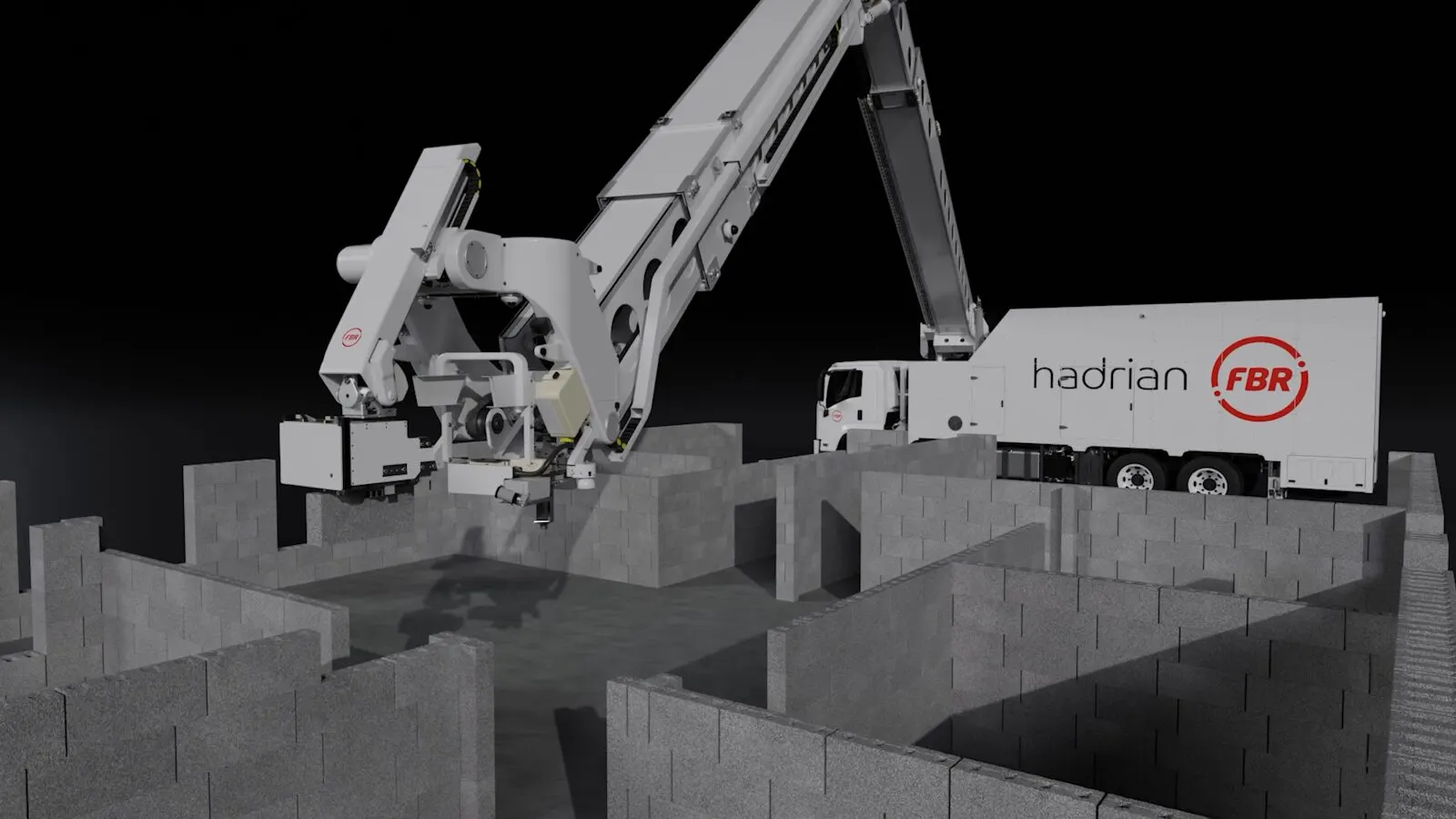
What it is
The Hadrian X, built by Perth-based FBR (ASX:FBR), is a truck-mounted bricklaying robot: a telescopic boom feeds large-format concrete blocks along its length to a layhead that places them into a wall with construction adhesive instead of mortar. The machine works from a 3D model of the building — the wall schedule is programmed, not supervised course by course.
Why the stabilisation matters more than the arm
Robotic arms that can stack blocks indoors have existed for decades. What kept them off real sites is that a 30-metre boom flexes, resonates and moves with wind, and a block placed from the end of it lands wherever the boom happens to be. FBR’s core patent — Dynamic Stabilisation Technology — measures and counteracts that movement in real time, so the layhead places blocks with millimetre-band accuracy outdoors, in wind, from a moving machine. That is the difference between a lab demo and a machine that can build the external walls of a house from the street.
The honest limits
The machine lays block walls — it does not do openings trades, services, roofs or finishes, and its economics depend on wall format, site access and repetition. FBR’s own path to market has run through partnership builds and a Wall as a Service model rather than machine sales, which tells you the commercial model is still being proven. Watch the metric that matters: blocks laid per hour on a customer’s site, not in a yard.
What it means on site
For builders, the near-term play is programme certainty on the masonry package: a machine that lays a house shell in a day or two collapses the critical path through structure, and the 3D-model-driven workflow forces the design to be resolved before the slab is poured — which is where the real productivity is hiding anyway.